
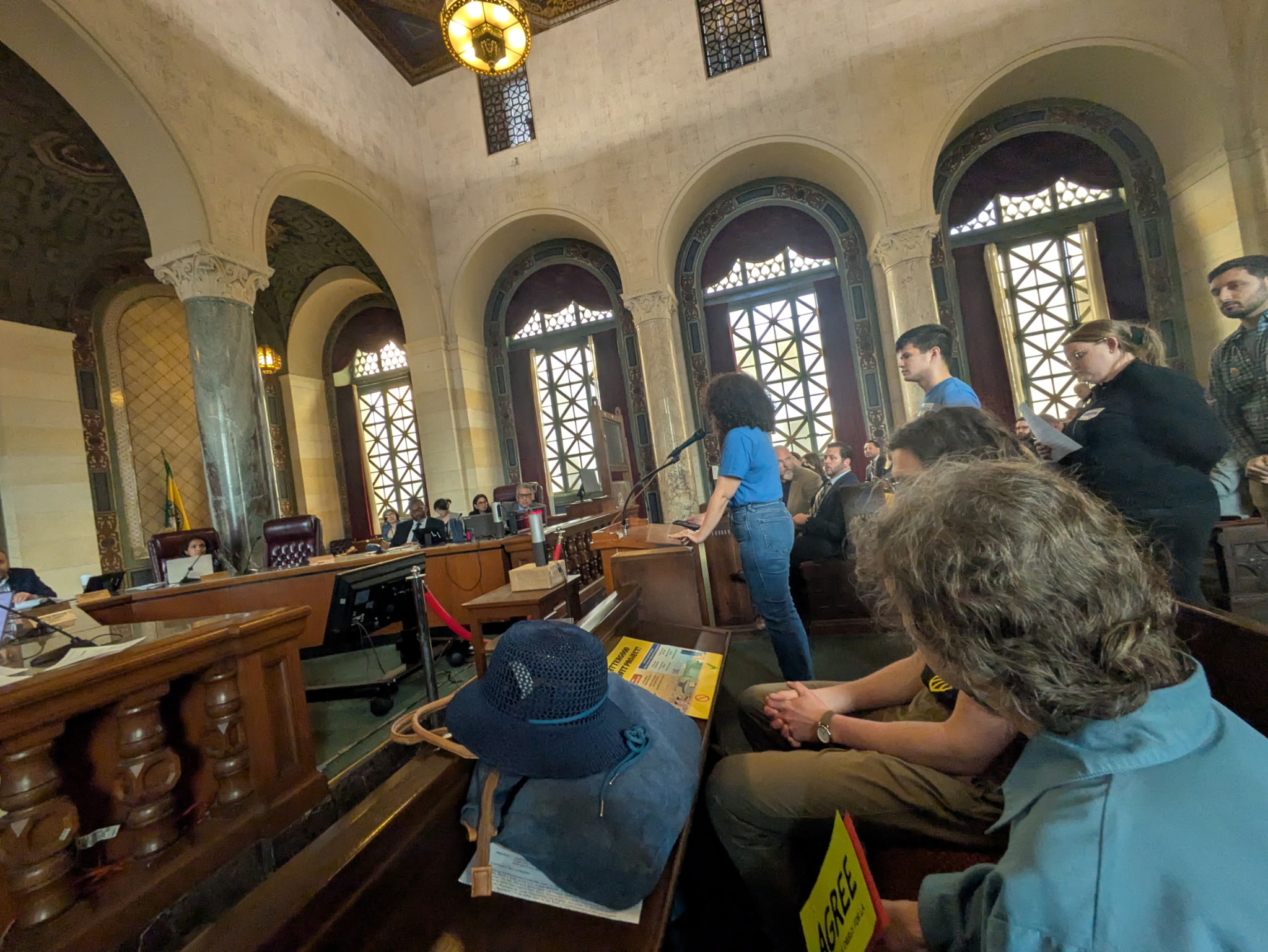
A controversial plan by the Los Angeles Department of Water and Power to retrofit the Scattergood power plant in El Segundo with hydrogen-burning turbines cleared a key hurdle at Los Angeles City Hall this week when the LA City Council’s Energy and Environment Committee voted to reject an appeal of the project’s Environmental Impact Report. The vote allows the environmental review to stand and sets up a potential vote before the full City Council later this month. Opponents argue the project is a costly way to keep fossil fuels flowing while saddling Los Angeles ratepayers with the bill.
At the center of the debate is a simple point raised repeatedly during a recent hearing before the City Council’s Energy and Environment Committee. Despite being marketed as a clean energy project, the proposal would require the plant to continue burning large amounts of methane gas, the primary component of natural gas and a fossil fuel, for years to come.
Andrea Vega, organizing manager for Food & Water Watch in Los Angeles, said the committee’s recommendation represents a troubling step in the wrong direction.
“The LA City Council’s Energy and Environment Committee’s recommendation to double down on LADWP’s misguided decision to move forward with retrofitting the Scattergood Gas Plant . . . is a major betrayal and deeply concerning, especially for the Angelenos living near the facility,” Vega said. “Hydrogen is an extremely water intensive industry scheme intended to keep us reliant on fossil fuels instead of investing in true climate solutions.”
Environmental advocates say it should not be surprising that LADWP is pushing the hydrogen retrofit. The utility has long resisted efforts to move more quickly toward a 100 percent renewable electricity system and maintains close ties with the fossil fuel industry, they argue. Advocates note that LADWP initially refused to study a pathway to fully renewable electricity before pressure from community groups and the City Council forced the analysis, and that the utility maintains significant financial relationships with Southern California Gas Company, which supplies methane to LADWP power plants.
Jonah Henry, a volunteer organizer with Sunrise Movement Los Angeles, said the committee’s vote reflects the continued influence of the fossil fuel industry in local energy policy.
“LADWP and City Council have decided to keep Los Angeles reliant on fossil fuel infrastructure for decades to come,” Henry said. “Today is a deeply depressing day for anyone in Southern California who cares about reducing electricity prices or solving the climate crisis.”
Scattergood is one of four remaining gas-fired power plants owned by LADWP. Built in 1958 along the coast near El Segundo, the plant had previously been slated for retirement as part of Los Angeles’ transition toward a 100 percent clean electricity grid. Instead, LADWP now proposes retrofitting two units to burn a blend of methane and hydrogen. City officials say the plant could eventually transition to hydrogen fuel, but large power plants operating entirely on hydrogen at this scale do not currently exist, and the environmental review did not analyze how hydrogen would actually be produced, transported, or delivered to the facility.
Even under LADWP’s own modeling, the plant would initially run on a mixture that is roughly 70 percent methane, a fossil fuel, and just 30 percent hydrogen. Environmental advocates say the proposal effectively locks Los Angeles into continued fossil fuel dependence while presenting hydrogen not as a viable clean energy source today, but as a speculative future solution.
The cost of doing so could also be enormous. The retrofit alone is estimated to cost at least $800 million based on projections presented to the city. That estimate does not include the cost of producing hydrogen fuel or building the pipelines and infrastructure needed to transport it. Analysts say rising turbine prices and supply chain delays could push the total cost significantly higher.
Ratepayer costs were a recurring theme throughout the hearing. Several residents and advocacy groups warned that hydrogen fuel currently costs seven to ten times more than methane gas and that customers could ultimately be responsible for the difference.
For many advocates, the issue is not only the price tag but the opportunity cost. Hundreds of millions of dollars directed toward retrofitting an aging fossil fuel plant, they argue, could instead be invested in expanding battery storage, modernizing the grid, and building the renewable infrastructure needed to support a fully clean electricity system.
Hydrogen combustion also raises concerns about air pollution and safety. Even when hydrogen is used as a fuel, burning it in turbines can produce nitrogen oxides, a major contributor to smog. In a city like LA, which was recently upgraded from “severe” to “extreme” nonattainment for ozone pollution, adding new combustion sources could worsen already dangerous air quality.
Environmental organizations say those risks highlight a broader flaw in LADWP’s planning process. In their view, the utility failed to seriously evaluate alternatives that could provide the same grid reliability without combustion, including long duration battery storage, distributed solar, demand response programs, and other emerging energy storage technologies that generate or store electricity without burning fuel.
The dispute reached the City Council after environmental organizations filed an appeal of the project’s Environmental Impact Report under the California Environmental Quality Act. The appeal was brought by a coalition including the Sierra Club, Food & Water Watch, Communities for a Better Environment, Los Angeles Waterkeeper, Physicians for Social Responsibility Los Angeles, and the Center for Biological Diversity.
At the March 3 committee hearing, dozens of speakers testified on both sides of the issue, including environmental groups, labor unions, hydrogen industry representatives, and LADWP ratepayers. Labor organizations emphasized the union jobs the project would create, while environmental advocates warned the project could prolong reliance on fossil fuels and undermine the city’s climate goals.
Faith Myhra, a volunteer organizer with Protect Playa Now, said the proposal represents a missed opportunity to pursue cleaner alternatives.
“My community does not want an expensive, dangerous, NOx-polluting replacement at Scattergood,” Myhra said. “I want a future where part of LA’s Virtual Power Plant is supported by battery storage built on the Scattergood site.”
Because Scattergood sits in Council District 11, the issue places particular scrutiny on Councilmember Traci Park, whose district includes many Westside communities closest to the plant and downwind of its emissions. On the LA City Council, members traditionally defer to the councilmember whose district is directly affected by a project, meaning Park’s position could carry significant weight if the issue reaches the full council.
Financial and political pressures surrounding the project may complicate that decision. Campaign finance records show Park has received $89,000 in contributions from Chevron, one of the world’s largest fossil fuel producers. The project has also been backed by International Brotherhood of Electrical Workers Local 18, which represents many LADWP workers and supports the retrofit because of the construction jobs it would create. The same union has endorsed Park in her council race, even as environmental groups warn about the project’s long term climate, pollution, and ratepayer impacts.
For Westside residents, the implications of the project are immediate. Keeping a decades-old fossil fuel plant running would mean continued air pollution from combustion, and could also lock ratepayers into paying for an expensive and uncertain technology rather than investing in the renewable energy systems the city says it wants to build. As the issue moves forward, many residents will be watching closely to see whether the councilmember representing the district listens to those concerns or sides with the political and financial pressures surrounding the project.
The appeal is expected to come before the full City Council on March 25, where councilmembers will decide whether to reject the Environmental Impact Report and require a new environmental review of the project. Community members are urging residents to contact City Council using this one-click email asking them to grant the appeal and reject the Scattergood EIR.