
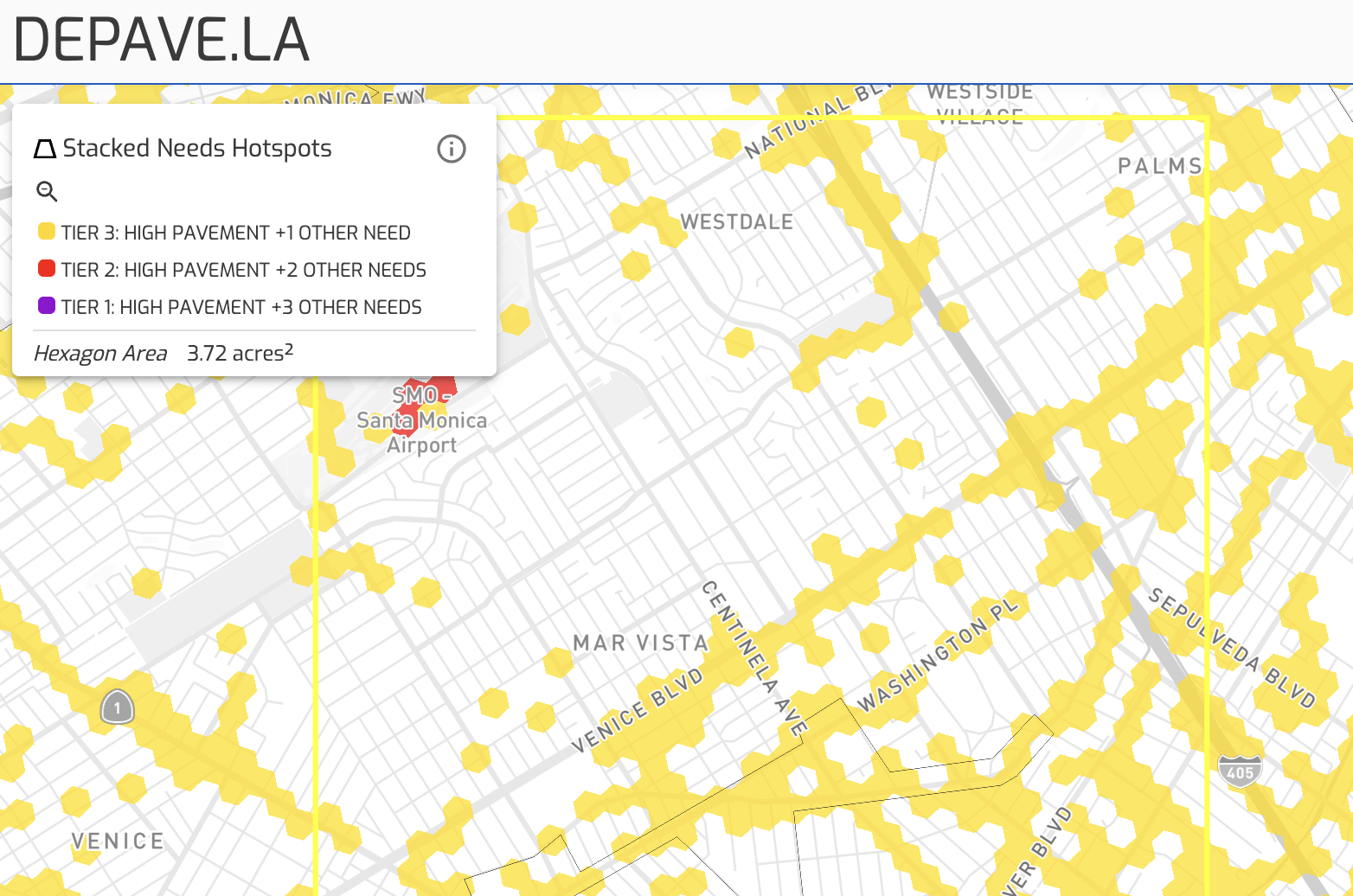
A new countywide pavement analysis is putting numbers behind something Los Angeles residents already feel every summer. Many neighborhoods are hotter, harsher, and less shaded than they need to be, and a significant share of that heat comes from pavement that does not serve an essential purpose.
The DepaveLA project finds that roughly 44 percent of Los Angeles County’s pavement may be non-essential, meaning it is not required for streets, sidewalks, or necessary access. Instead, it is concentrated in parking lots, apartment complexes, schoolyards, and commercial properties where it intensifies heat, worsens flooding, and limits opportunities for trees and shade.
At the neighborhood level, the Mar Vista map is revealing. Like other higher-resource neighborhoods, Mar Vista has less non-essential pavement overall than many parts of the county. Still, distinct heat corridors are visible along Venice Boulevard, Centinela Avenue, and Washington Place, with additional clusters at Mar Vista Elementary School, Mar Vista Recreation Center, commercial strips, and multifamily housing areas.
Low-income residents and communities of color are overrepresented in Los Angeles’ rent-stabilized housing, which in Mar Vista is largely concentrated along these higher-pavement corridors. This makes the pattern an environmental justice issue, as many renters face greater exposure to heat-retaining asphalt and reduced access to shade and green space compared with residents on lower-density residential blocks.
The analysis also challenges the assumption that streets are the primary source of excess pavement. Researchers found that nearly 70 percent of non-core pavement is located on private property, including apartment courtyards converted to hardscape, parking areas surrounding commercial centers, and residential spaces where drought concerns have led to paving rather than climate-adapted landscaping.
For families living in apartments, the effects are cumulative. Daily routines often involve moving between paved sidewalks, courtyards, parking areas, and schoolyards with little opportunity for cooling shade. That makes school campuses a particularly important part of the conversation.
Mar Vista Elementary offers a glimpse of what a different approach can look like. The school’s planned Playground and Campus Exterior Upgrade project aims to transform what has historically been an asphalt-dominated campus into a greener, more climate-resilient environment by replacing portions of paving with lawn and planting areas, expanding tree canopy, and creating shaded outdoor learning spaces. The project is part of LAUSD’s Green Schoolyards initiative and is designed to incorporate stormwater capture, increase greening, and provide healthier outdoor environments for students.
District planning documents indicate the campus upgrade will remove tens of thousands of square feet of paving while adding landscaping and accessibility improvements, reflecting a broader shift toward schoolyards that mitigate heat rather than amplify it.
That shift is significant because schools often function as neighborhood green space, particularly for families living in apartments without yards. When campuses become cooler and greener, the benefits extend beyond students to parents, caregivers, and the surrounding community.
The broader takeaway from the DepaveLA analysis is not that pavement should be removed everywhere. Rather, it highlights how incremental redesign across many sites could meaningfully improve neighborhood conditions. Parking lots represent one of the clearest opportunities. Adjusting layouts, adding tree wells, and incorporating stormwater features can reduce paved area while preserving access and functionality. Residential properties also present potential through smaller interventions that collectively contribute to cooling and improved livability for all our neighbors.