
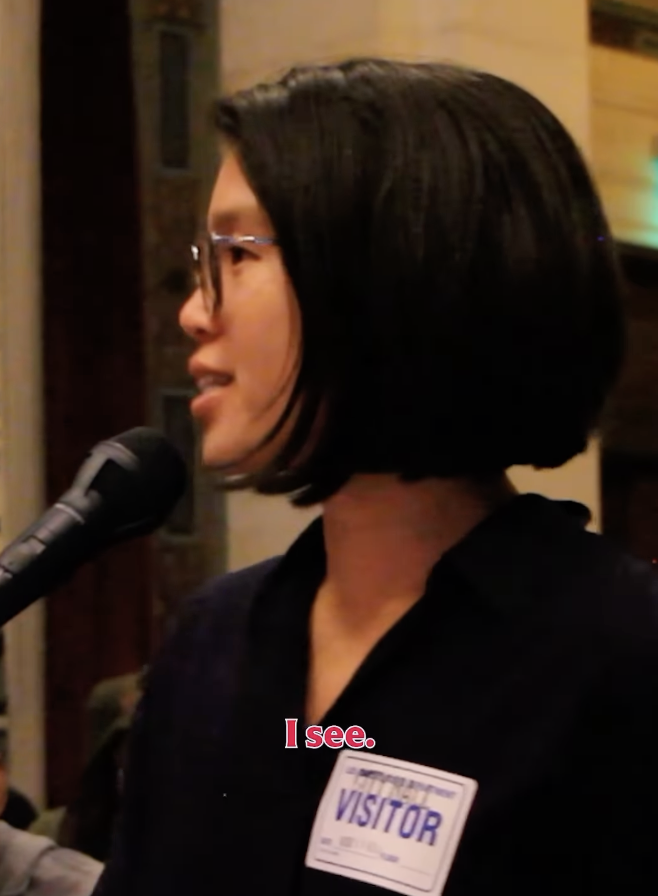
Rae Huang stepped to the microphone this week at a meeting of Los Angeles’s Charter Reform Commission to speak about police accountability. Before she finished, the microphone was cut.
Huang kept speaking without amplification as people in the audience stood and urged commissioners to continue hearing public comment. Within minutes, the meeting adjourned after commissioners left the room and the body lost quorum. LAPD officers were then called in to clear the chamber.
Videos of the moment spread quickly online, but the confrontation did not come out of nowhere. It was the result of months of tension over whether the commission tasked with reshaping LA city government would seriously address policing and accountability. The charter determines how authority is distributed among the mayor, the City Council, and major departments, including how police oversight is structured. Because those rules are written into the charter itself, structural changes to policing are difficult to achieve without going through this process.
From early on, the commission faced delays and slow appointments, leaving less time to complete its work. Commissioners acknowledged publicly that the compressed timeline made it harder to take up complex and controversial topics. Questions about transparency and independence also surfaced, with some commissioners and observers warning that the process risked losing public confidence if it appeared rushed or overly constrained.
Policing became one of the most contentious issues in that environment. For much of the commission’s work, advocates and community groups have argued that LAPD oversight and discipline were not being given sufficient attention. Organizers held teach-ins and circulated letters urging the commission to put police reform squarely on the agenda, arguing that charter reform will be incomplete if it does not address one of the most powerful institutions in city government.
Eventually, policing did reach the agenda, but by then frustration had been building for months. Families affected by police violence, organizers, and candidates have begun attending meetings in greater numbers to make sure the issue remained part of the discussion.
That is the context for this week’s meeting. According to reporting from the room, several speakers had already given public comment, including relatives of people killed by law enforcement who urged stronger accountability measures. Commissioners later said the allotted time for in-person public comment had ended and staff were preparing to move to remote speakers when the situation became tense. Some commissioners left the meeting, causing a loss of quorum, and the meeting was adjourned.
What followed is what many people saw online: the microphone cut, people continuing to speak, and officers directing attendees to leave. Commission leadership has said that public participation remains essential to the process and encouraged residents to submit written comments and attend future meetings. But the episode reinforces concerns that the commission is struggling to build trust at a moment when the stakes are unusually high.
The LAPD remains the largest department in city government and one of the most powerful institutions in Los Angeles. Decisions about how oversight works, who holds authority, and how accountability is structured are central questions in charter reform, not peripheral ones. For advocates who have spent months pushing the commission to address policing, the abrupt end to the meeting felt like another setback in a process they already viewed as slow and uncertain.