
This article was originally published in Truth About Traci
Regan Cole-Graham was seven months pregnant. She was riding her bike with her husband and their two small children near their home in Playa del Rey when a car struck her on Pershing Drive. She was rushed to the hospital. Doctors delivered her baby girl. Regan died. Her daughter survived briefly in the NICU, then died too. Her sons, ages three and eighteen months, witnessed the crash. One of them was also hit.
There are no words for that kind of loss. There are, however, clear facts about how this happened and why.
Los Angeles is in the middle of a traffic violence epidemic. Hundreds of people are killed on city streets every year. Traffic crashes are the leading cause of death for children and teens in Los Angeles. Cyclists and pedestrians are routinely killed on wide, high speed roads designed to move cars quickly rather than protect human beings. This is not a mystery. City leaders know this and have known it for years.
What makes Regan’s death especially enraging is that the City of Los Angeles already knew how to make Playa del Rey safer and then chose not to sustain those changes.
In 2017, Los Angeles launched a major street safety pilot in Playa del Rey under then Councilmember Mike Bonin. The project reduced car lanes and installed protected bike lanes on Pershing Drive, Jefferson Boulevard, Culver Boulevard, Venice Boulevard, and Vista del Mar. The purpose was explicit and aligned with city policy: slow traffic, reduce collisions, and prevent deaths. Transportation officials estimated the changes could prevent roughly sixteen severe injuries each year.
The backlash from drivers was immediate. Commuters who used Playa del Rey as a cut through to avoid the 405 flooded City Hall with complaints. Online petitions accused the City of creating one lane madness. Fundraising campaigns were launched to finance lawsuits. Organizers openly threatened to recall Bonin unless the lanes were restored.
Under that pressure, the City reversed course. Within months, Bonin announced that car lanes would be restored and protected bike lanes removed, including on Pershing Drive. The rollback was framed as a response to community concerns, but recall organizers publicly acknowledged that the reversal was driven by political pressure and the growing recall effort. Anti road diet groups celebrated, boasting that residents had gotten their road back. Even after the safety infrastructure was torn out, those same groups continued litigation to block it from ever being reinstated.
As a result, Pershing Drive was returned to its prior condition. The road where Regan was killed is now five lanes wide, with a posted speed limit of 35 miles per hour and real world speeds that routinely exceed 45. Painted bike lanes, flashing beacons, and signage do little to slow drivers on a roadway engineered for speed and throughput. These measures are cosmetic, not protective. Speed determines whether people live or die in crashes, and wide roads encourage speeding. The City’s own Mobility Plan 2035 designates this area for safer, lower stress travel. Los Angeles knew how to redesign Pershing Drive and did so briefly. It then chose to undo those changes.
That retreat did not just reshape the street. It reshaped Westside politics.
Opposition to street safety measures did not disappear after 2017. It evolved. By 2021, a second recall effort against Bonin was underway. This time, the movement was framed less around road diets alone and more around homelessness, traffic congestion, and resistance to changes that challenged the Westside status quo. Many of the same neighborhood activists and NIMBY networks that had opposed bike lanes, Vision Zero projects, and street redesigns were deeply involved. These were the same circles that demanded no street improvements, fought housing, and pushed aggressively for the removal of unhoused people from public space.
This was the political environment in which Traci Park rose. Her early supporters came from the same networks that had mobilized against Bonin’s safety projects and were central to the second recall push. Park understood where her political base was on the Westside and aligned herself accordingly. She adopted its framing and priorities and has remained aligned with them as an elected official.
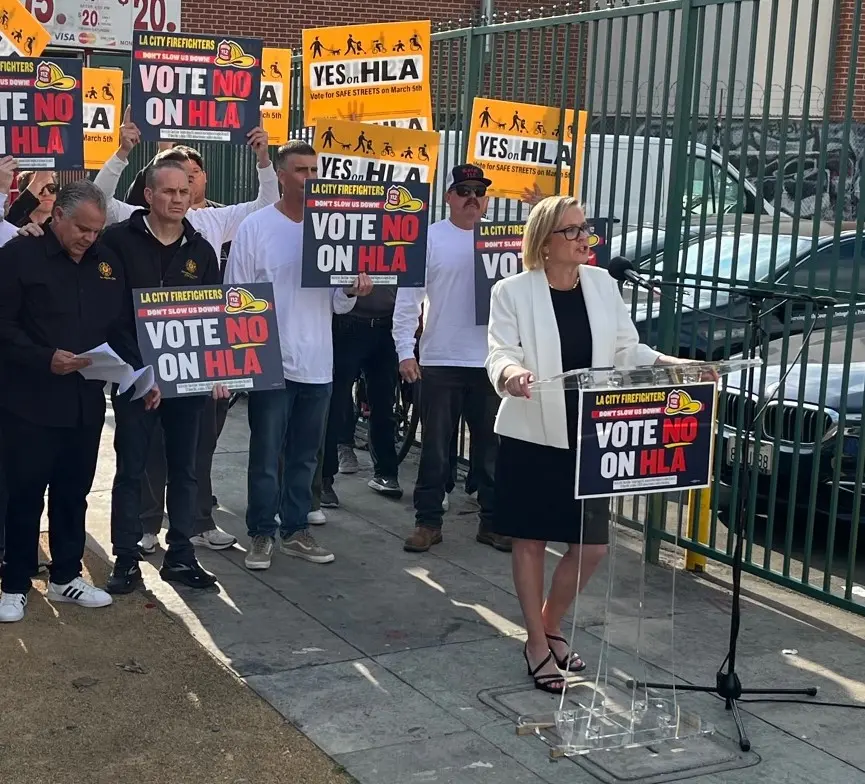
Since taking office, she has governed consistently with that alignment. She opposed the Venice Boulevard safety improvements. She publicly opposed Measure HLA, the initiative that requires Los Angeles to implement its own adopted street safety plans as roads are repaved. She aligned with firefighter leadership and other opponents to block a citywide policy designed to prevent exactly the kind of conditions that persist on Pershing Drive. HLA passed anyway, by overwhelming margins, including in Council District 11.
After Regan’s death, Park issued a statement offering condolences and calling the killing a tragedy. What she did not mention was Pershing Drive itself. She did not mention speed or road design. She did not acknowledge that protected bike lanes once existed in this corridor and were removed after the kind of backlash she has consistently legitimized. By stripping the policy context from the death, she presented it as an abstract misfortune rather than the foreseeable result of political choices.
Mourning without accountability is not leadership. It is damage control.
Park’s selective concern for safety makes the pattern clearer still. The only bike lane she actively supports is on Jefferson Boulevard, and even that support followed a large scale sweep that removed unhoused people living in RVs along the corridor. Park cited the former encampment as a reason to install the lane. Cyclists say the Jefferson project does not connect to bike facilities on either end. One end dead ends near Ballona Creek, which already has a safe, separated path. The other empties into Jefferson itself, a high speed car sewer. There is no publicly released route map, no clear timeline, and no integration into a functioning network. By any reasonable standard, the project does nothing to meaningfully protect cyclists and functions primarily as an exclusionary measure.
People have died on Pershing Drive before. They die there with disturbing regularity. Most of the time, the victims are poor, working class people, often people of color. Their deaths rarely make headlines. There are no viral fundraisers or anguished statements from elected officials. This time, the victim was a white, pregnant, highly accomplished professional riding with her family. That is why City Hall is paying attention and why Traci Park is speaking now. That contrast is not incidental, but part of the same moral failure.