
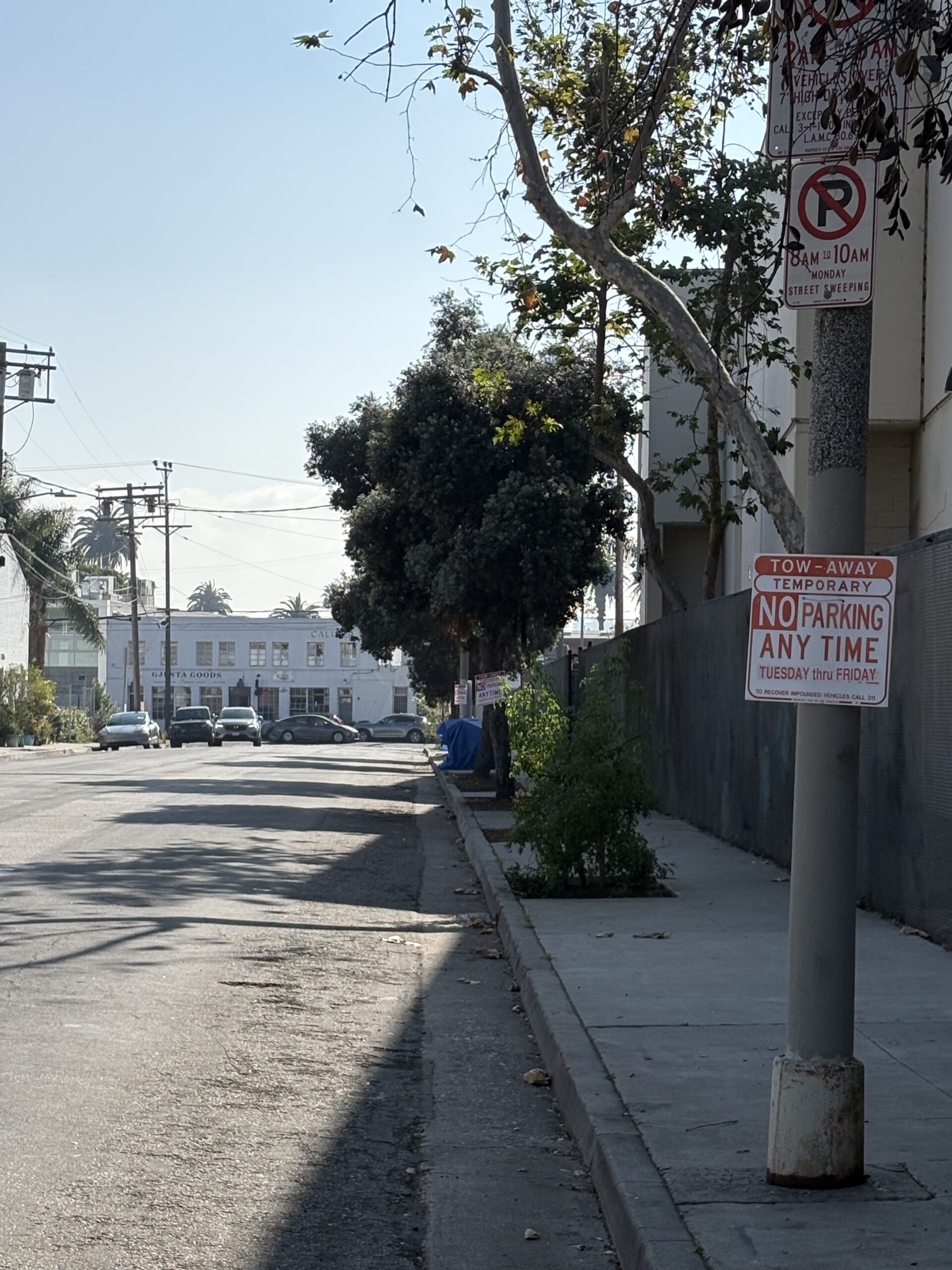
Two weeks ago, Venice was papered over with temporary No Parking signs block after block. There were no public works projects, no construction, and no special events. These weren’t random streets. They were the exact blocks where people live in RVs, vans, and even ordinary vehicles because they have nowhere else to go.
During the same week, sidewalks known for encampments were swept daily outside of their typical once a week or every other week schedule.
Not coincidently, all of this happened during the week of the Annual LAHSA Point-in-Time Homeless Count.
I stopped in my tracks when I saw it. My immediate reaction wasn’t confusion, it was recognition. I could only think of one word: excessiveness. When texting my friend to share what I was witnessing, I asked her if excessiveness was even a word. It is. And it turns out to be the most accurate description of Traci Park’s homelessness strategy in Venice.
Displacement Dressed Up as Results
Traci Park wants voters to believe homelessness in Venice, as well as CD11, is declining because of her leadership. She points to numbers. She points to “progress.” She mostly points to cleanups of encampments and towing of RVs to “make a better CD11.” But what she does not point to is housing, because housing is largely absent from the story.
The RAND LA LEADS study, which followed homelessness trends longitudinally in neighborhoods including Venice, makes this painfully clear. The reported decline in Venice was not driven by people being housed. It was driven primarily by a reduction in people living in vehicles.
That’s not a solution. That’s enforcement.
RAND found no meaningful housing interventions in Venice during the study period that could explain the drop. What did change was pressure on the unhoused themselves: parking restrictions, enforcement actions, and forced movement. People didn’t disappear because they got keys. They disappeared because they were pushed out of sight.
Even worse, RAND documented an increase in people sleeping rough outside, without any shelter at all. When you criminalize vehicle dwelling with towing and dismantle encampments by throwing away tents without providing housing, people don’t magically stabilize, they become more vulnerable, more mobile, and more invisible.
That’s not reducing homelessness. That’s manufacturing it in a less photogenic form.
The Convenient Timing of “Success”
The LAHSA Point-in-Time Homeless Count is already a weak measurement tool. It is a short, weather-dependent snapshot that undercounts people every year. RAND has repeatedly shown that traditional counts miss large portions of the unhoused population, especially when people are forced to move frequently.
So when Venice suddenly sees an explosion of temporary no-parking signs and intensified sweeps during the count itself, the question isn’t cynical, it’s obvious: Are the numbers going down, or is Traci Park just clearing the stage long enough to claim a win?
In an election year, the distinction matters.
Los Angeles has been sweeping encampments for decades. Under mayors and councilmembers of every political stripe, the outcome has been the same: homelessness does not decline, it relocates. Venice today, Mar Vista tomorrow. RVs one month, doorways the next. For Los Angeles, homelessness is a giant game of kicking the can down the road.
Yet Park continues to double down on enforcement, because enforcement creates the illusion of control. It looks decisive. It photographs well. And it allows her to say, “Look how I reduced homelessness,” without ever having to answer the harder question: Where did people actually go?
Excessiveness Isn’t Compassion, It’s Evasion
What I saw two weeks ago in Venice wasn’t balance. It wasn’t evidence-based policy. It was indeed pure excessiveness. Excessive policing of poverty, excessive reliance on displacement, and excessive confidence that voters won’t look past surface-level numbers.
We all know truth, even RAND as well, that Park seems intent on ignoring: housing ends homelessness. Sweeps don’t. Parking bans don’t. Moving people around like chess pieces doesn’t.
So yes, not only is excessiveness a real word… in Venice, it has become a governing style.
If Traci Park wants to run on homelessness “reductions,” she should start by showing plans where to locate people to with actual housing outcomes, not cleared sidewalks, emptied streets, and temporarily improved optics timed perfectly for a count.
Until then, excessiveness may be her most honest legacy. It just shouldn’t be public policy.