
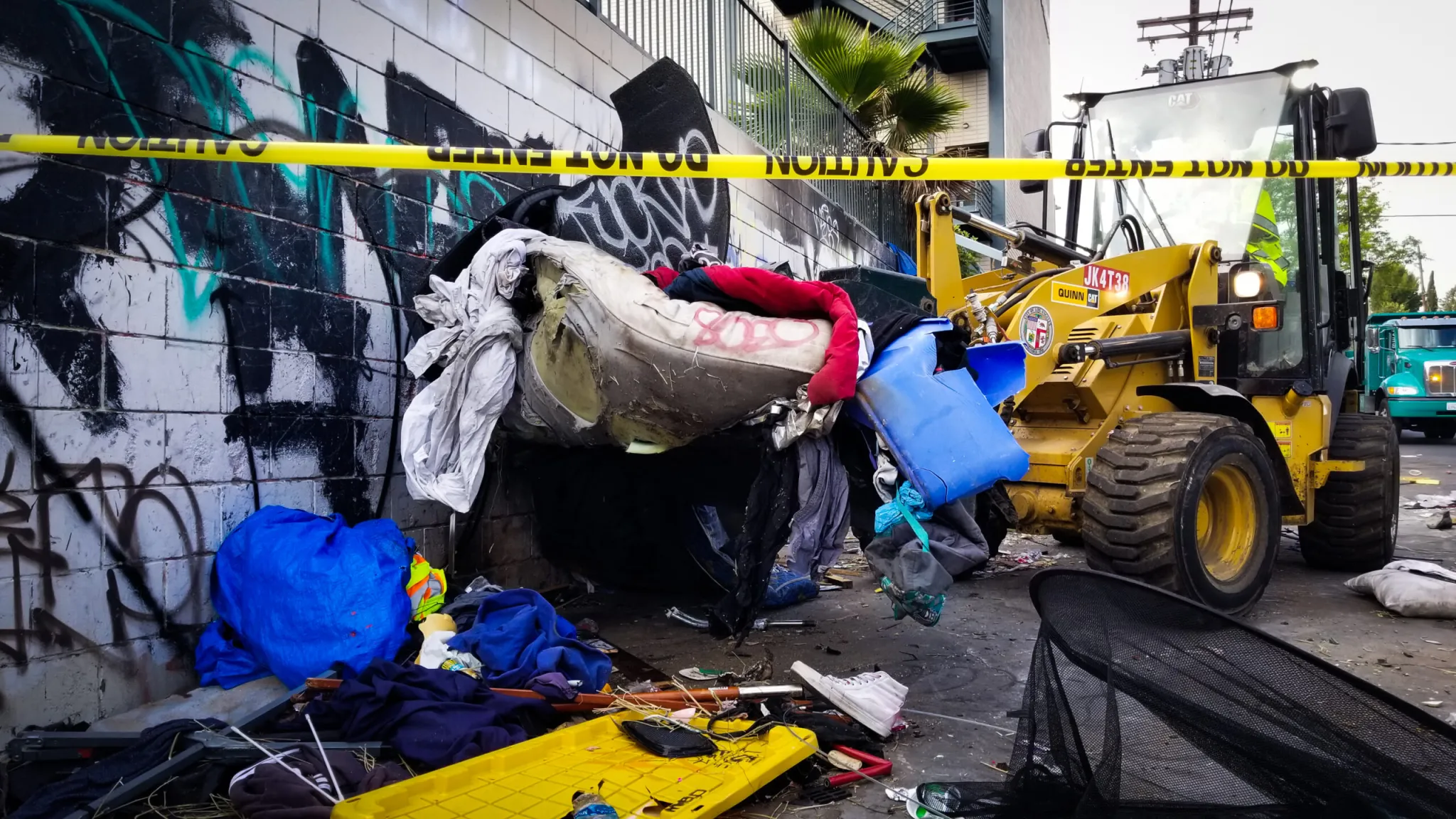
A new report on Los Angeles’s CARE+ operations in Council District 11 finds a homelessness response centered on displacement rather than housing or services.
The report, co-published by the CD11 Coalition for Human Rights, the Venice Justice Committee, and UCLA’s Luskin Institute on Inequality and Democracy, examines what CARE+ actually looks like on the ground in Venice. Its findings land in a policy context that has been years in the making.
CARE+ grew out of Los Angeles’s long-running encampment cleanup machinery and was formalized citywide in late 2019 under the Garcetti administration as the city rebranded how it schedules and carries out sweeps. City officials described the program as a shift away from one-off cleanups toward neighborhood-based teams that would return to the same areas, pair sanitation with outreach, and frame the work as public health rather than punishment.
In practice, CARE and especially CARE+ became the city’s standardized sweep infrastructure. CARE+ operations are not limited to trash pickup. They are comprehensive cleanings that often involve clearing encampments, tagging and removing property deemed a health or safety hazard, and resetting public space. Outreach workers may be present, but the operation itself is built around removal.
A defining feature of CARE+ is that it is routinely conducted with law enforcement involved. Police presence is not incidental, but shapes how the operations unfold. When enforcement is part of the sweep, some people flee before meaningful outreach can happen, and those subjected to police interaction are often traumatized by those experiences. Belongings, documents, medication, and survival gear are often lost in the process. And these operations cost Los Angeles taxpayers tens of millions of dollars each year, not including law enforcement.
CARE+ was briefly paused early in the COVID pandemic, then brought back with renewed assurances about coordination and care. What unhoused residents and advocates have described since is a familiar cycle. Operations are scheduled, often in response to complaints from housed residents routed through council offices. Sanitation crews, outreach staff, and police arrive together, people are told to move, the site is cleared, and those who are displaced reappear nearby because they were never offered a real place to go.
That is the context for the new CD11 report. It centers a basic question: what does CARE+ actually translate into on the ground? To answer that question, the report draws on direct observation of 13 CARE+ operations in Venice over four months in 2025, a follow-up survey of 51 unhoused residents about displacement and outreach, and a review of Councilmember Traci Park’s newsletters and social media communications about CARE+ and encampments.
What it finds is stark. CARE+ deployments averaged roughly 15 city staff and 10 city vehicles per operation, yet across those days only 9 of 44 displaced people received any homeless services outreach. Just five survey respondents reported being offered help accessing shelter or housing before or after displacement. Most had been forced to move repeatedly, often four or more times in a single month, frequently at the direction of LAPD.
Over that same four month period, Councilmember Park’s newsletters and social media posts mentioned encampment removals 48 times, compared with just three mentions of services or housing assistance. The emphasis mirrors what CARE+ crews do on the ground. They arrive in force, clear an area, and move on. What happens to the people displaced is largely outside the frame.
As UCLA professor and report co author Chris Tilly puts it, CARE+ is “not about care,” and that is a policy choice.
The report places these outcomes in the context of an enforcement environment that has intensified across Los Angeles. Litigation brought by the Los Angeles Alliance for Human Rights has pushed the city to demonstrate visible encampment reductions, translating court oversight into numerical targets and timelines. That orientation was underscored by a recent court ruling finding that the City of Los Angeles illegally approved a sweeping encampment crackdown in secret, violating the Brown Act. Plans to clear thousands of encampments were developed behind closed doors, without public debate.
At the same time, a California Public Records Act disclosure released last week show how enforcement pressure is also generated locally in Council District 11. The records, tied to the oversized vehicle ordinance, document sustained demands from housed residents for the removal of vehicle dwellers, expanded tow away zones, and faster enforcement, along with an office eager to deliver.
The tone of those demands is often openly dehumanizing, and Park’s office repeatedly reassures constituents that the legal tools they want are coming. She commits to continuing the steady expansion of oversized vehicle restrictions under the city’s 80.69.4 ordinance, adding new tow away zones block by block to fulfill resident requests. At the same time, Park has made sweeping promises about rushing through enforcement under Assembly Bill 630, presenting it as the mechanism that will finally allow the city to seize and destroy RV homes outright. That promise has now collided with reality. Earlier this month, a judge ordered Los Angeles to halt its rollout of AB 630, finding the city lacks the legal authority to use the law in the way Park described.
CARE+ operates at the intersection of these forces. Legal pressure rewards visible clearance, neighborhood hostility rewards rapid removal, and political incentives reward responsiveness to both. The result, as the report documents, is a system optimized for displacement, with outreach becoming secondary at best. The report’s findings align with broader human rights research showing that enforcement driven homelessness responses predictably destroy personal property, interrupt medical care, sever relationships with outreach workers, and expose unhoused people to increased risk of illness, injury, and death. Repeated displacement does not resolve homelessness, but entrenches it by making stability impossible.