
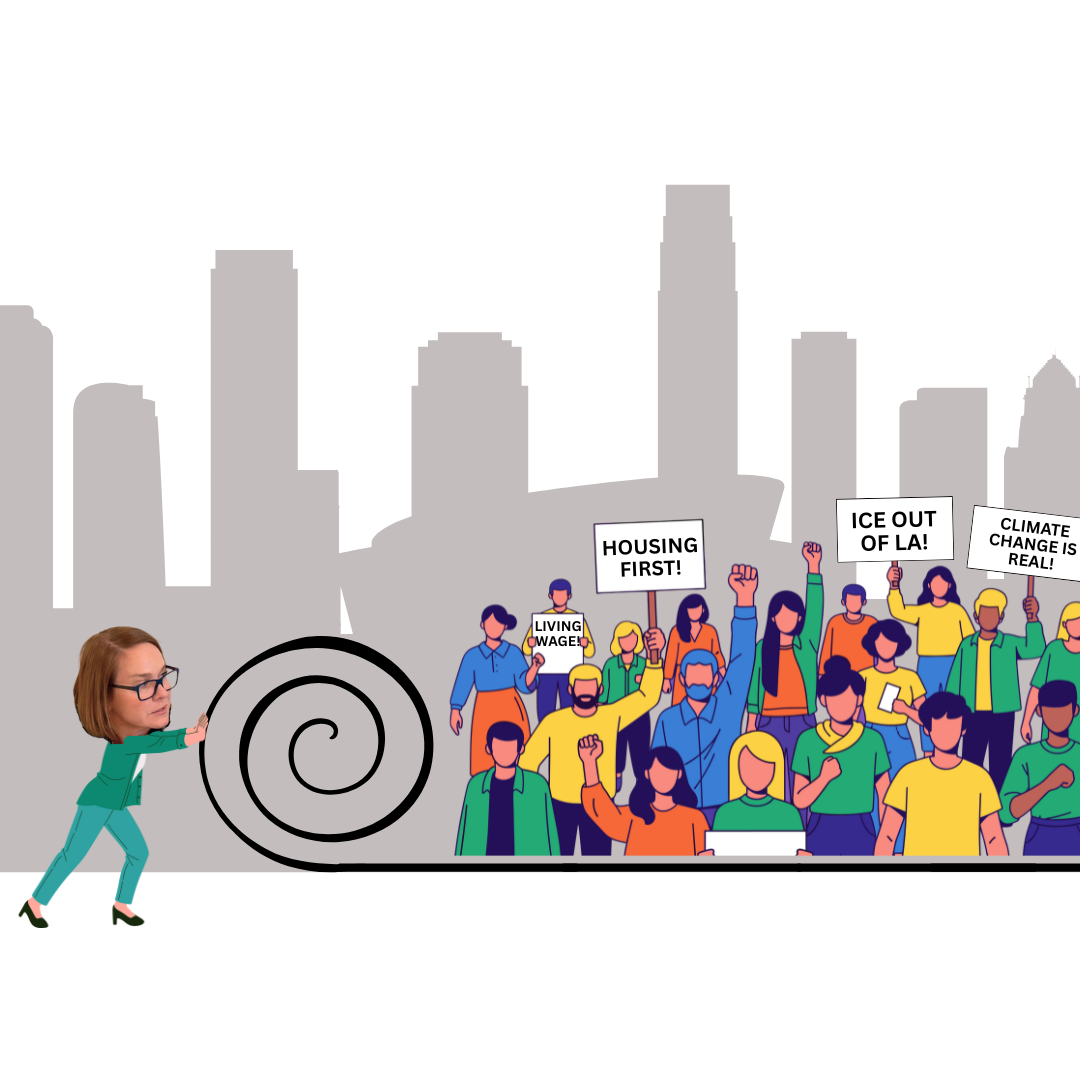
Traci Park’s recent interview with the Westside Current reveals a councilmember on the defensive. As scrutiny intensifies across housing, homelessness, immigration, climate, labor, and tenant policy, Park appears to be responding not by recalibrating or engaging new realities, but by retrenching into familiar right-wing positions and recycled political attacks aimed at consolidating her base.
The interview was published by the Westside Current, an outlet founded and run by Park’s former communications director, Jamie Paige. Paige now writes for the right-wing New York Post owned by Rupert Murdoch, which has announced plans to launch a California edition aimed at expanding its brand of Trump-aligned media to the West Coast. The Westside Current has increasingly functioned as a local analogue to that model, serving as Park’s mouthpiece at a moment when scrutiny of her record is intensifying.
On homelessness, Park leans further into an enforcement-first approach. She argues that Los Angeles has “doubled down on failure” for decades, dismisses Housing First as ineffective, and insists the city cannot “build its way out” of the crisis. Yet Los Angeles has never come close to producing housing at the scale required to meet need, particularly on the Westside, where deeply affordable housing has been virtually nonexistent for decades. In short, we’ve never pursued a true “housing first” policy in LA. Venice Dell itself was proposed precisely because of that historic underproduction. Declaring housing a failed strategy while blocking one of the few 100 percent affordable projects in the area reflects not pragmatism, but ideological opposition.
Park’s framing of unhoused people underscores this shift. She divides residents into those “sane enough and sober enough” to accept help and those she characterizes as too difficult to serve, arguing the city needs authority to compel treatment. This rhetoric aligns with post Grants Pass crackdowns and marks a move further right on homelessness policy. It also mirrors the dehumanizing language now used by President Trump, which frames homelessness as a problem of disorder to be controlled rather than a housing crisis to be solved. That approach ignores extensive evidence showing that coercive responses increase cycling through jails, hospitals, and courts while failing to produce long-term housing stability. In District 11, encampment clearances have not reduced homelessness. They have produced repeated displacement, high public cost, and growing legal exposure for the city.
Nowhere is Park’s defensive posture clearer than on Venice Dell. She characterizes the project as politically manufactured, widely opposed, and rooted in fraud and corruption. Those claims conflict with the documented record. Venice Dell went through nearly a decade of public process, including extensive community outreach, multiple Planning Commission hearings, repeated City Council votes, and environmental and coastal review. It survived two lawsuits brought by opponents, with courts rejecting those challenges in full. The California Coastal Commission approved the project unanimously. The City Council previously voted 12 to 0 to uphold its entitlements. All legal challenges to the project itself have failed. The delays that remain stem from internal city actions taken after Park assumed office .
Allegations of fraud have not been supported by any court ruling, audit, or investigative finding. Judges explicitly rejected the legal theories advanced by project opponents. Repeating those accusations after litigation has concluded introduces no new evidence and instead functions as a political attack designed to cast doubt on a project Park has been unable to stop through formal processes.
As pressure mounts, Park has increasingly turned to familiar political bogeymen. The interview revives attacks on her predecessor, Mike Bonin, portraying him as an ongoing force behind Venice Dell and related political activity. That framing is false. Bonin is now a private citizen and has no role in decision-making around the project. He is not directing policy or exercising influence over litigation or city actions. Recycling Bonin as an antagonist signals a defensive turn, reaching backward to slander a private citizen rather than engaging present-day facts.
Park also leans heavily on red-baiting rhetoric, repeatedly invoking the Democratic Socialists of America as a catchall villain. Rather than addressing specific policy disagreements, she uses the DSA as shorthand for extremism or outside influence. Unfortunately for Park, that strategy is increasingly disconnected from political reality. In New York City, democratic socialist Zohran Mamdani was elected mayor with broad support, running explicitly on housing affordability, public services, and economic justice. Los Angeles has four City Council members affiliated with the DSA, all elected by voters in competitive races. And democratic socialists are winning offices across the country in response to constituents demanding material improvements in housing, wages, healthcare, and public infrastructure.
Park’s recent decision to bring on Michael Trujillo as a spokesperson and campaign strategist only reinforces this posture. Trujillo is one of the most notorious political consultants in LA, known less for winning campaigns than for inflammatory tactics. In 2011, he was fired mid-race after boasting in a campaign email, “We are about to put a political bullet in between Rudy Martinez’s forehead and make him pee in his pants,” describing himself as a cat toying with a “dead rat.”
As public pressure builds over Park’s opposition to sanctuary city protections during aggressive ICE enforcement, her climate denialism in the wake of catastrophic fires, and her consistent record opposing tenant protections and workers’ rights, Park is at odds with both the policy evidence and broader public sentiment. Taken together, the interview reflects a councilmember narrowing her appeal rather than expanding it. Her choice to bring in one of L.A.’s most divisive political operatives while doubling down on attacks against unhoused people, immigrants, and long-resolved housing proposals shows a campaign operating from fear, not vision. She has chosen to move even farther to the right, attacking familiar ideological targets, and recycling old political antagonists because her approach will further erode conditions for renters, workers, immigrants and unhoused residents.