
A Los Angeles Superior Court judge has ruled that the City of Los Angeles violated California’s open meeting law when the City Council secretly approved a sweeping plan to remove nearly 10,000 homeless encampments, a decision that now raises deeper questions about how major city policy is being shaped behind closed doors.
In a 10 page ruling issued this week, Judge Curtis Kin found that the City Council violated the Ralph M. Brown Act during a Jan. 31, 2024 closed session in which councilmembers approved an encampment removal strategy tied to the city’s long running legal settlement with the LA Alliance for Human Rights. The plan set a target of clearing 9,800 encampments over four years, a goal that has since driven sanitation operations and enforcement across Los Angeles.
Under the Brown Act, legislative bodies may meet in closed session “to confer with, or receive advice from, its legal counsel regarding pending litigation” when open discussion would prejudice the agency’s position. But the statute draws a clear boundary between legal advice and policymaking.
Judge Kin found that the city crossed that boundary. “What the City cannot do under the Brown Act,” he wrote, “is formulate and approve policy decisions in a closed session outside the public eye merely because such decisions are in furtherance of a settlement agreement.”
The ruling is a significant victory for the Los Angeles Community Action Network, which sued the city after learning that the encampment plan had been approved without public notice, debate, or disclosure. Advocates argued that the secrecy surrounding the plan deprived the public of any meaningful opportunity to weigh in on one of the most consequential homelessness policies the city has adopted in years.
According to LA CAN, the city never publicly released the encampment removal plan before or after the closed session. The only known disclosure was to the business community, which obtained a copy that was later submitted to federal court by the LA Alliance.
“The City Council approved an extremely controversial plan to clear almost 10,000 encampments entirely in secret,” said Shayla Myers, an attorney for LA CAN. “They never disclosed the plan before they voted on it, or even after.”
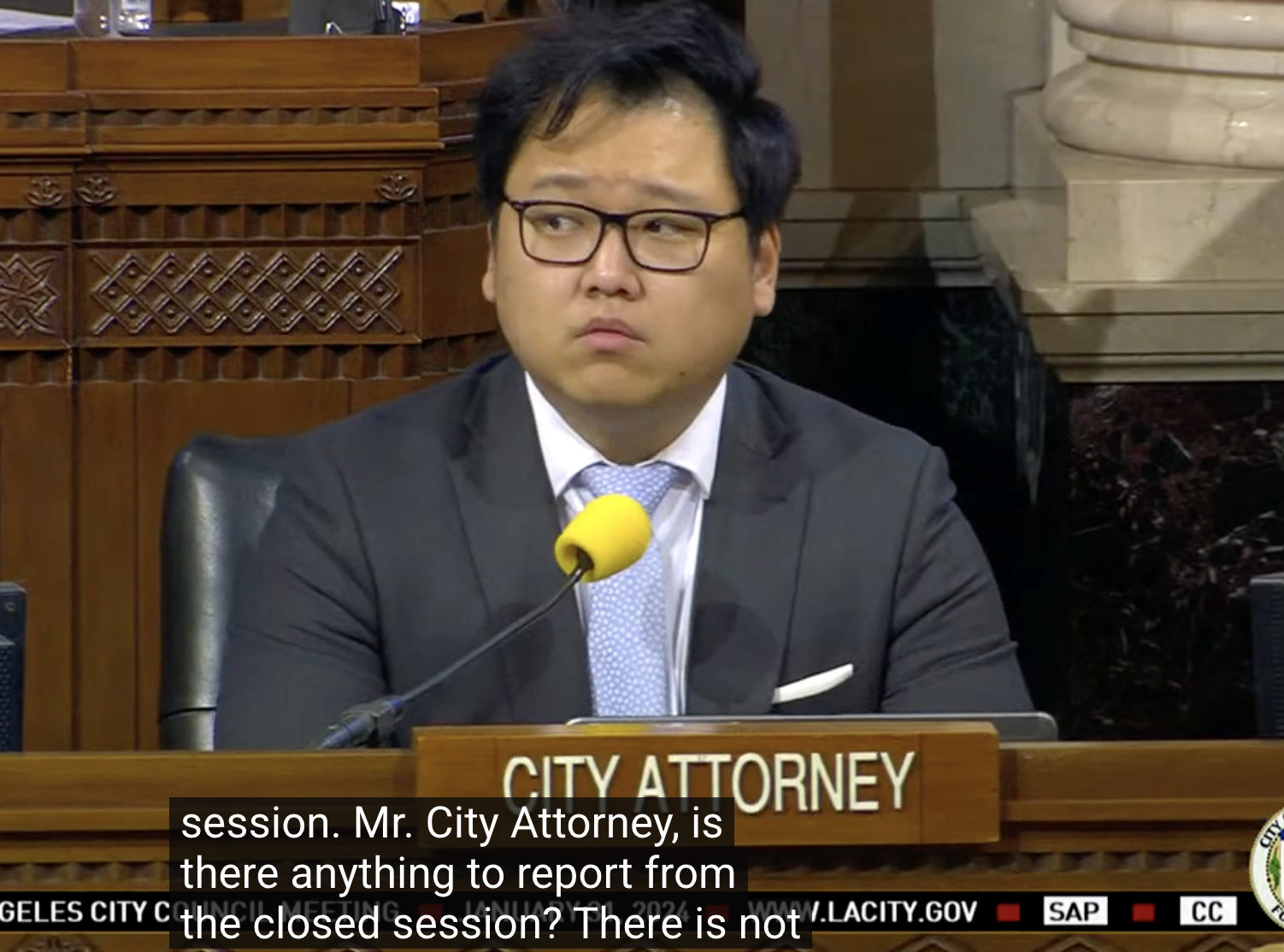
City officials have maintained that no vote occurred during the closed session, a claim that has only intensified scrutiny. Video from the Jan. 31, 2024 council meeting shows councilmembers entering closed session to discuss the LA Alliance litigation and returning without reporting any action. Deputy City Attorney Jonathan Groat told the public there was nothing to report.
Yet the encampment plan later surfaced as an approved document. In court filings, the city acknowledged that the plan and its milestones had been presented to the Council during the closed session. LA CAN demanded records showing how it was authorized, including any vote tally or audio recording of the deliberations. The city declined, asserting that no disclosure was required.
Judge Kin rejected that position. He found that the Council “approved the encampment plan” during the closed session and that the approval constituted a policy decision subject to the Brown Act’s open meeting requirements. LA CAN is now seeking a court order requiring the city to produce records from the closed session to establish precisely how the decision was made.
The ruling has implications beyond homelessness policy. The City Council routinely enters closed session under Government Code section 54956.9 to discuss pending litigation, including high dollar liability cases involving police violence, civil rights claims, and enforcement related harms. The Brown Act permits those sessions only “to confer with, or receive advice from, legal counsel.” Kin’s decision makes clear that once the Council moves from receiving legal advice to approving a course of action, setting targets, or directing implementation, it has crossed into policymaking that must occur in public. The encampment plan ruling now forces scrutiny of whether closed sessions across City Hall are being used strictly for litigation strategy, or to quietly shape policy outside public view.
Kin’s decision now raises a broader question about whether those sessions are being used strictly “to confer with legal counsel,” as Government Code section 54956.9 permits, or whether substantive policy decisions are being developed behind closed doors and later implemented without public debate, disclosure, or accountability.
The secrecy surrounding the encampment plan also matters because of its real world consequences. Under the settlement framework, the city committed to removing 9,800 encampments by this summer, a target advocates say has effectively functioned as a quota system. They warn that pressure to meet numerical goals increases the risk that sanitation workers will seize and discard tents and personal property without first offering shelter or housing, in violation of constitutional protections.
Those concerns have already been borne out in federal court. U.S. District Judge David O. Carter ruled that a tent can only count toward the city’s encampment removal goal if the person living there has first been offered housing or shelter. The ruling directly undercut how the city had been tracking compliance and prompted City Attorney Hydee Feldstein Soto’s office to argue that the judge had “reinterpreted” the settlement terms.
The encampment plan is part of a broader legal saga that began in 2020, when the LA Alliance sued the city and county, alleging systemic failure to address homelessness, particularly in Skid Row. The city settled in 2022, agreeing to create nearly 13,000 new shelter beds or housing placements by June 2027. Negotiations over how aggressively the city would reduce encampments dragged on for more than a year, frustrating the Alliance and eventually leading it to seek sanctions.
In February 2024, the Alliance told Judge Carter that the city was more than 400 days late in finalizing its encampment strategy and submitted the plan to the court, stating it had been approved by the City Council during the Jan. 31 closed session. That revelation triggered LA CAN’s lawsuit and ultimately Judge Kin’s ruling.
Kin also found that the city violated the Brown Act a second time in May 2024, when councilmembers met in closed session to discuss an agreement governing coordination between the city and Los Angeles County on homeless services delivery, again without public disclosure of the policy decision that followed.
Taken together, the findings suggest a pattern in which closed sessions were used not merely to receive legal advice, but to approve policy frameworks that shape how homelessness is governed citywide.
The ruling arrives amid intensifying scrutiny of the city’s homelessness response. Judge Carter has already found Los Angeles out of compliance with the LA Alliance settlement and ordered the city to pay $1.6 million in legal fees to the Alliance, along with more than $200,000 to LA CAN and the LA Catholic Worker. City attorneys have said they intend to appeal those fee orders.