
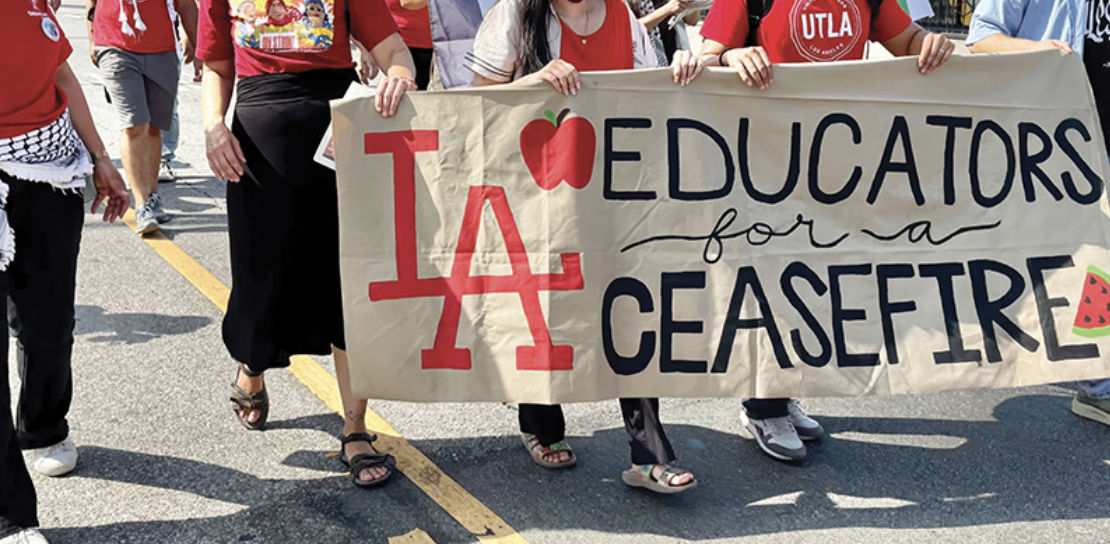
United Teachers of Los Angeles has taken one of the most consequential steps yet by a major local labor union to link its political power to opposition to the genocide in Gaza, voting to withhold congressional endorsements from candidates who supported sending U.S. weapons to Israel.
The vote, taken December 17 by UTLA’s House of Representatives, passed 56 to 44 after weeks of internal debate and years of organizing by rank and file educators. The motion directs the union to refrain from endorsing candidates whose voting records include support for weapons transfers that educators say have enabled mass civilian harm and the destruction of educational institutions in Gaza.
Supporters of the motion framed it as a natural extension of educators’ core values. Teachers repeatedly pointed to the scale of devastation to Gaza’s school system, including the bombing of universities, primary schools, and refugee education centers, as well as the killing of students, professors, and education workers. For many, the question was no longer whether a teachers union should weigh in on foreign policy, but how it could justify staying silent while schools and children were being systematically destroyed.
While the December vote does not name a specific bill, it is widely understood to apply most clearly to the April 20, 2024 House vote approving billions of dollars in military assistance to Israel during the Gaza war. That vote, which passed overwhelmingly, has become a central reference point for labor and ceasefire advocates because it directly authorized weapons transfers at the height of civilian casualties. UTLA organizers have pointed out that some Los Angeles members of Congress voted no, demonstrating that alternatives existed even under intense political pressure.
The endorsement policy now lands squarely on several LA area incumbents who supported that package and who have long relied on labor backing as a foundation of their electoral strength. Among them is Rep. Ted Lieu, whose Westside and South Bay district includes thousands of educators and union households. Lieu has cultivated a national reputation as a progressive voice on democracy and the rule of law, yet he voted for the April 2024 supplemental without conditions, a decision that has drawn sustained criticism from peace groups and educators.
In neighboring districts, Reps. Jimmy Gomez, Brad Sherman, Nanette Barragán, and Robert Garcia also supported the weapons package, placing them on the same side of the vote despite representing constituencies with large numbers of union members and voters increasingly opposed to U.S. arms transfers. In Gomez’s case, that vote is now a central point of contrast with a Justice Democrats–backed challenger who has made opposition to arming Israel a core part of her campaign, while Sherman and Barragán face growing pressure from activists seeking to turn what was once a symbolic critique into a serious electoral challenge. Garcia, who later co sponsored efforts to restrict future arms sales, is also being scrutinized by educators who argue that after the fact course corrections do not undo a vote that helped authorize weapons deliveries during an active assault.
The decision builds on earlier steps taken by UTLA. In October 2024, the union voted to support congressional efforts to block roughly $20 billion in U.S. military aid to Israel, backing resolutions introduced by Senator Bernie Sanders and others that sought to halt offensive weapons transfers unless international humanitarian law was respected. Educators involved in the effort consistently framed the issue as one of priorities, pointing to overcrowded classrooms, staffing shortages, and aging school facilities in Los Angeles while Congress rushed through weapons funding with little debate.
Inside the union, the Gaza vote was the product of sustained grassroots organizing rather than a top down directive. Committees including the Human Rights Committee and the Raza Educators Committee spent years building support, educating members, and pushing leadership to take firmer positions. Organizers say the relatively close vote reflects how far the conversation has moved, not how divided educators are, noting that similar resolutions would have been unthinkable within UTLA just a few years ago.
Educators are also extending the fight beyond elections. UTLA members have joined campaigns urging the California State Teachers’ Retirement System to divest from weapons manufacturers, military contractors, surveillance firms, and Israeli banks linked to settlement expansion and military operations. Teachers argue that their deferred wages should not be invested in industries that profit from war, particularly when those wars target schools and children.
As UTLA’s stance has hardened, so has the backlash. Pro Israel advocacy groups have accused the union of stepping outside its mission and have attempted to frame the endorsement policy as discriminatory. Civil rights organizations including CAIR Los Angeles have pushed back, defending educators’ right to criticize Israeli government policy and warning against conflating such criticism with antisemitism as a means of silencing dissent.
Nationally, UTLA’s decision places it at the leading edge of a broader shift within the labor movement. Unions including the United Auto Workers and several SEIU locals have taken positions opposing U.S. military aid to Israel or calling for a ceasefire. Teachers unions at the state and national level are now grappling openly with how to respond to Gaza, academic freedom, and political accountability. As the 2026 election cycle approaches, UTLA has made clear that endorsements will no longer be automatic. Candidates seeking the support of Los Angeles teachers will be asked not only how they plan to fund schools, but whether they are willing to draw clear lines when it comes to war, civilian protection, and the right of children everywhere to learn without fear.