
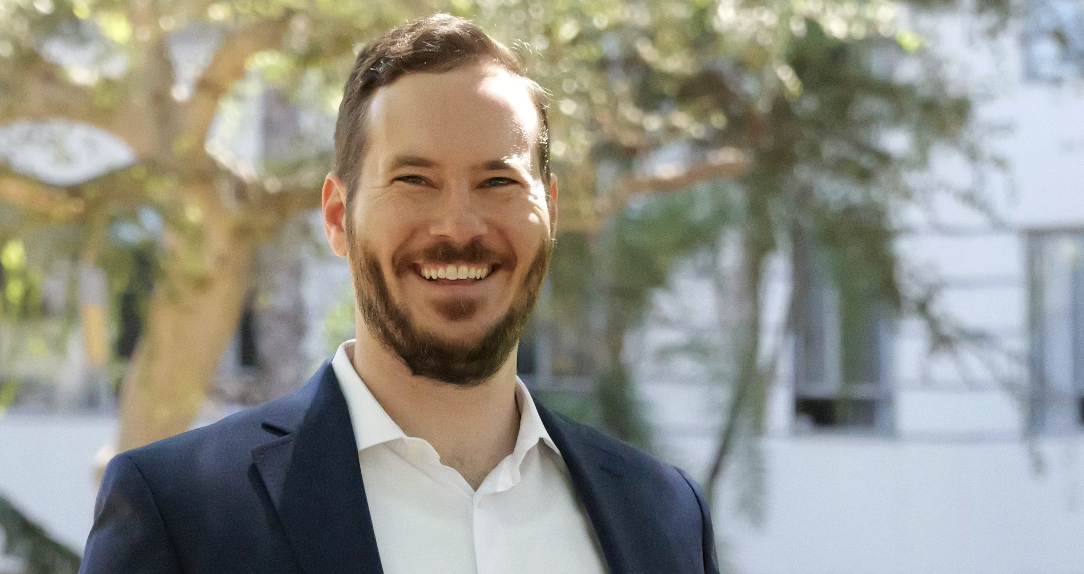
Henry Mantel is running for LA City Council District 5 with a simple argument that cuts against years of City Hall equivocation. The housing crisis is not an abstract policy problem or a matter of tone. It is the central failure driving displacement, homelessness, street safety, and rising inequality across Los Angeles, and the city cannot meaningfully address any of those issues without confronting housing scarcity head on.
Mantel is a tenants’ rights attorney who has spent most of the past five years representing renters facing eviction, harassment, and unsafe living conditions. He grew up in the district, in Hancock Park, attended Harvard Westlake, left Los Angeles for college at Brandeis University, and later attended law school in Sacramento. He returned to Los Angeles after taking the bar exam in 2019, and when COVID hit soon after, he began doing eviction defense work with Neighborhood Legal Services, representing tenants across the north side of Los Angeles County.
That work, he says, fundamentally shaped his politics. Over and over, he encountered tenants who had legal protections on paper but no real leverage in practice. Even when renters were in the right, even when landlords violated the law, the outcome was often the same. People were forced to move because they could not afford to stay, and there was nowhere else to go.
“I’ve represented hundreds of tenants,” Mantel said. “I can understand situations where someone has to move. I’ve never represented anyone who I thought deserved homelessness.”
One case in particular crystallized the scale of the crisis for him. While representing a tenant in the Antelope Valley who had no legal defense against eviction, Mantel assumed the client would at least be able to find another affordable apartment. Instead, he discovered there were no studio units renting for less than about $1,400 a month, even that far from the city core. The client ultimately had no viable housing option.
“That was the moment where it really hit me,” Mantel said. “This is the Antelope Valley, and there is nowhere to go.”
Those experiences led him to a conclusion he returns to repeatedly. Strong tenant protections are necessary, but they are not sufficient. Rent stabilization can slow rent increases for some tenants, but it cannot make Los Angeles affordable. Legal defense can buy time, but it cannot create housing that does not exist.
That is why Mantel has made zoning reform the centerpiece of his campaign. He argues that Los Angeles has effectively made it illegal to build enough housing in most of the city, limiting new development to a small fraction of land while preserving vast areas of single-family zoning even near major transit corridors, universities, and job centers. In District 5, he points to single-family zoning around UCLA, the Purple Line extension, and major redevelopment areas as emblematic of policies that lock scarcity in place.
From that perspective, Mantel is sharply critical of Councilmember Katy Yaroslavsky’s record. He points to her opposition to SB 79, a state bill aimed at allowing more housing near transit, as a revealing vote. While largely symbolic at the city level, Mantel argues it signals a broader resistance to upzoning that will matter when implementation decisions come before the council. He also criticizes efforts to limit ED1 fast-tracking of 100 percent affordable housing in historic districts, arguing that historic preservation is too often used as a justification for blocking new housing.
On homelessness, Mantel is unequivocal. He opposes encampment sweeps and Inside Safe operations, which he says have failed to reduce homelessness while inflicting trauma and displacement. He argues that criminalization does not resolve homelessness so long as people have nowhere else to go.
“We’ve been doing sweeps for years,” Mantel said. “There are still people sleeping on the street. It hasn’t actually changed anything.”
Mantel connects the housing crisis to street safety and transportation as well. He supports Vision Zero, Measure HLA, and substantial pedestrian and bike safety improvements, including lane reductions, speed enforcement, and in some cases pedestrian-only streets. He describes street safety as inseparable from housing and land use, arguing that car-dependent planning and underinvestment in walkable communities compound risk and inequality.
More broadly, Mantel argues that Los Angeles is undermining its own fiscal stability by refusing to allow more people to live here. With property taxes constrained by Proposition 13, he sees housing production as one of the only realistic ways to expand the tax base and sustainably fund basic services, from street maintenance to transit to libraries.
Asked how voters should judge his performance if elected, Mantel does not promise quick fixes. Instead, he says success should be measured by whether it becomes legal to build significantly more housing across District 5 and whether that capacity begins to translate into real construction. Without structural change, he argues, no amount of enforcement or programmatic tinkering will reverse decades of underbuilding.
Mantel is candid about the uphill nature of his campaign as a challenger to an incumbent with deep institutional support. He does not expect to outraise his opponent. Instead, he is betting on sustained organizing, tenant outreach, and a message that refuses to split the difference between housing abundance and housing obstruction.