
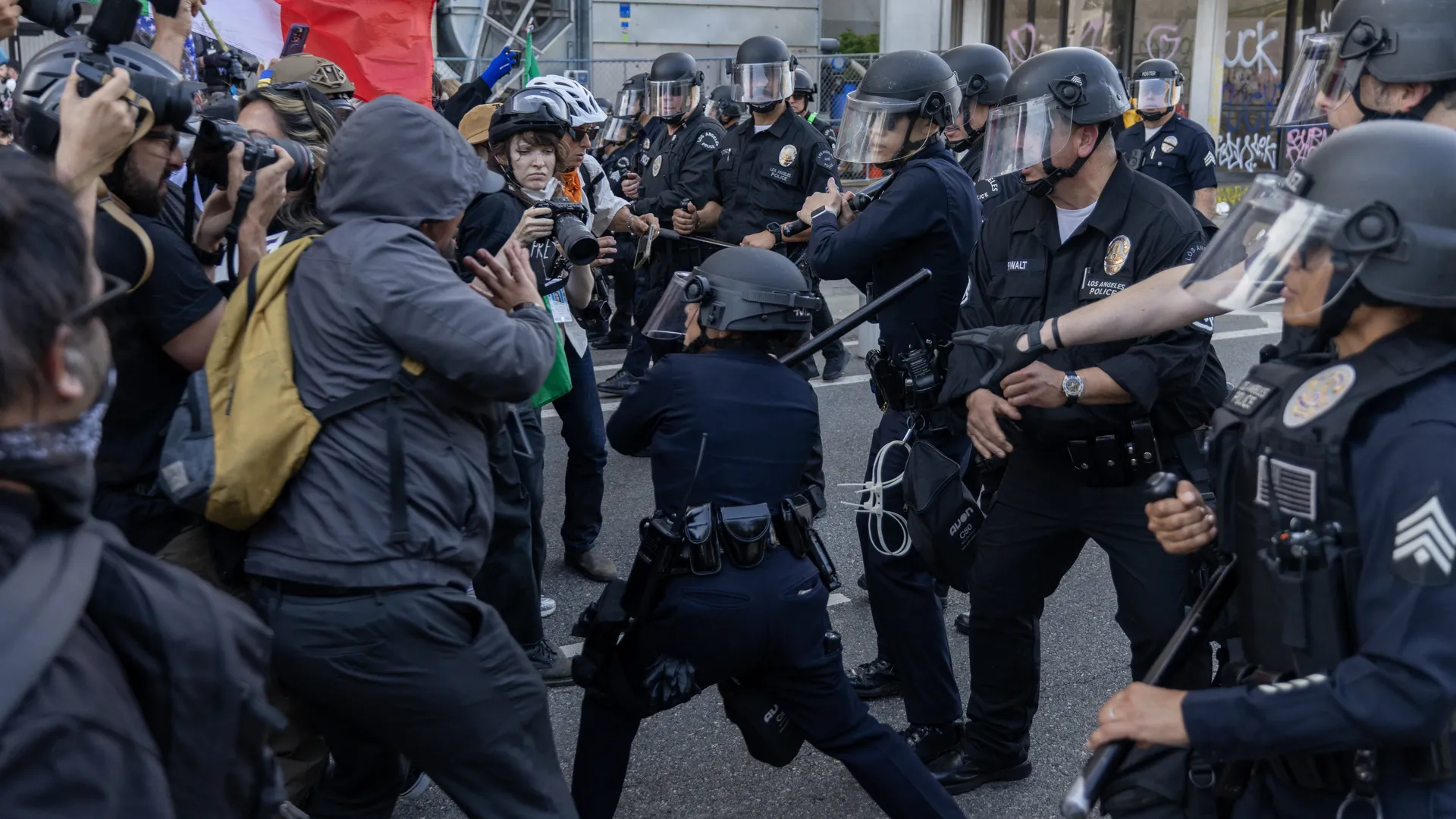
LAPD has failed to meet multiple state deadlines to publicly report its use of less lethal weapons during the June 2025 protests, deepening concerns about the department’s accountability and the City Council’s unwillingness to impose oversight. State law requires LAPD to disclose why these weapons were fired, how many rounds were used, and what injuries occurred. Those reports were due months ago. None have been published.
The missing documentation covers a period when officers fired more than a thousand 40 millimeter rounds, pepper balls, and tear gas canisters during several days of protests against ICE and in support of immigrant rights in Los Angeles. At least six people were seriously injured, including a journalist who underwent hours of surgery after being struck in the eye and a protester hospitalized with brain bleeding. Videos from those nights show munitions launched at close range into crowds, a pattern that state lawmakers sought to bring under public scrutiny through AB 48.
The failure to provide these reports now casts a harsher light on the City Council’s recent decision to approve LAPD’s military equipment authorization under AB 481. The day before that vote, City Controller Kenneth Mejia publicly urged the council to reject the department’s annual equipment report, warning that LAPD was not in full compliance with state law. AB 481 requires police departments to disclose how they use a wide range of tactical equipment, including the same 40 millimeter launchers and chemical agents deployed during the June protests. The law also requires detailed summaries of use, costs, policies, complaints, and any purchase requests. Mejia’s statement made clear that LAPD had not met these requirements. Despite that warning, the council majority approved the authorization anyway.
The reporting lapse under AB 48 and the council’s vote under AB 481 reflect the same dynamic. The city continues to rely on LAPD to follow transparency rules that the department has repeatedly failed to meet. When the council voted down a separate proposal to temporarily pause the use of 40 millimeter rounds and tear gas until LAPD could demonstrate compliance with state law, members pointed to internal processes and future assurances rather than the legal requirements already in place. The missed AB 48 deadlines now show those assurances were unfounded.
Civil rights advocates note that both AB 48 and AB 481 were enacted to address well documented injuries from less lethal weapons during the 2020 protests and to prevent precisely this kind of information vacuum. Yet Los Angeles is again unable or unwilling to provide the transparency the laws demand. LAPD continues to deploy weapons capable of inflicting serious harm, and the council continues to authorize their use, even when the department cannot produce the required public reports.
The result is a city where disclosure laws exist on paper but disappear in practice. LAPD cites workload and complexity for its delay. The council declines to enforce consequences. And the public is left piecing together what happened from lawsuits, hospital records, and scattered footage while the official record remains incomplete or entirely absent.