
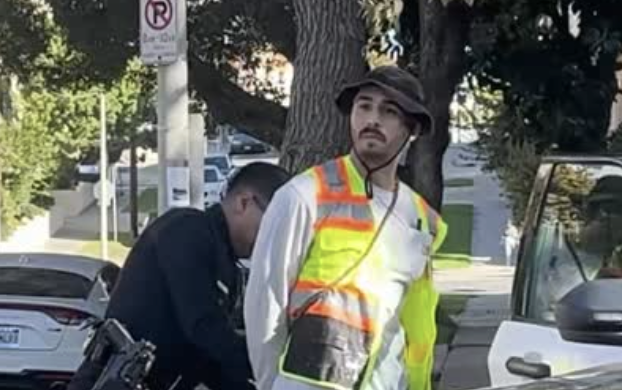
Jonathan Hale, a law student and pedestrian safety advocate, was arrested this week while painting a white crosswalk at an unmarked intersection in Westwood. The volunteer-led action was organized by People’s Vision Zero, a grassroots group working to improve pedestrian safety by painting crosswalks at intersections that already qualify as legal under state law.
Hale said the group selected the intersection based on data from the city’s Vision Zero program, which tracks locations where pedestrians have been injured or killed while crossing the street. The nearest recorded incident occurred at Midvale and Wilkins, one block east of the site, where a pedestrian was hit in 2020. In early October, Hale submitted a 311 request for a crosswalk at that corner and notified city officials of the group’s intent to take action if no response was received. So the Westwood location was part of a broader effort to target intersections already identified as dangerous by the city’s own records. As with other actions, the group used traffic-grade paint and followed state guidelines for legal crossings. Because the intersection was not within 600 feet of a school, they used white paint instead of yellow. LAPD officers arrived within minutes and detained Hale. A fire truck and ambulance were also dispatched.
While the city has previously removed community-painted crosswalks, Hale’s arrest marks a new level of enforcement. He is the first member of People’s Vision Zero to be arrested during such an action. In an interview, Hale said the incident revealed the city’s stance on community-led safety efforts. “We forced their hand and they showed the world what their priority is.”
People’s Vision Zero maintains that their work is legally grounded. California Vehicle Code § 275 defines a crosswalk as the area between sidewalks at an intersection, even if it is unmarked, and Vehicle Code § 21950 requires drivers to yield to pedestrians in both marked and unmarked crosswalks. Hale argues the city’s failure to acknowledge these legal crossings, combined with slow implementation of new markings, contributes to dangerous conditions.
Hale has repeatedly challenged the city’s assertion that community-painted crosswalks create legal liability. “In that case, anything that invites pedestrians into the street creates liability,” he said. He pressed the Mayor’s office to clarify its position, arguing that if painted markings truly increase liability, then the city should remove all crosswalks, official or otherwise. Taking that argument to its logical conclusion, even signs warning drivers to “drive like your kids live here” would present a liability concern. While the Mayor’s staff initially thanked him for his advocacy, Hale said their response was ultimately dismissive.
He contrasted that response with his experience working with Councilmember Heather Hutt’s office. Hale said her staff was more open to collaboration and suggested the group consider formally incorporating or partnering with an existing nonprofit to enable a more official relationship with the council office. While the proposal would still involve bureaucratic hurdles, Hale said it was a notable departure from the posture of the Mayor and other city departments.
The arrest comes amid broader concerns about the city’s delay in implementing safety infrastructure. Last year, more Angelenos were killed in traffic fatalities than in homicides. According to Hale, more than 10,000 pedestrians were injured or killed in Los Angeles crosswalks between 2015 and 2025. And according to LAPD data, over 1,500 people suffered severe injuries in collisions in 2024 alone. Despite this, the city often removes unpermitted interventions like crosswalks within days, while approved improvements can take years.
Hale also pointed to a recent investigative report showing that the city has quietly scaled back its street repaving program. By opting for temporary slurry seals instead of full repaving, the city avoids triggering requirements for ADA curb ramps and compliance with the voter-approved Healthy Streets LA ordinance. He cited this as further evidence of how Los Angeles does everything it can to avoid long-term safety upgrades, even when there is funding and widespread public demand. 70% of crashes resulting in death or severe injury occur at intersections, yet the city often fails to act until tragedy strikes. Speeding is a factor in 35% of all fatal collisions citywide.
Looking ahead, Hale believes the city should support new models for pedestrian improvements, including public-private partnerships. He pointed to examples abroad, like in Paris, where the city worked with corporate sponsors to fund crosswalks and curb extensions. Hale suggested that similar frameworks could be adapted in Los Angeles to allow nonprofit or private entities to participate in delivering basic safety infrastructure.
To learn more about People’s Vision Zero, visit them on Instagram.