
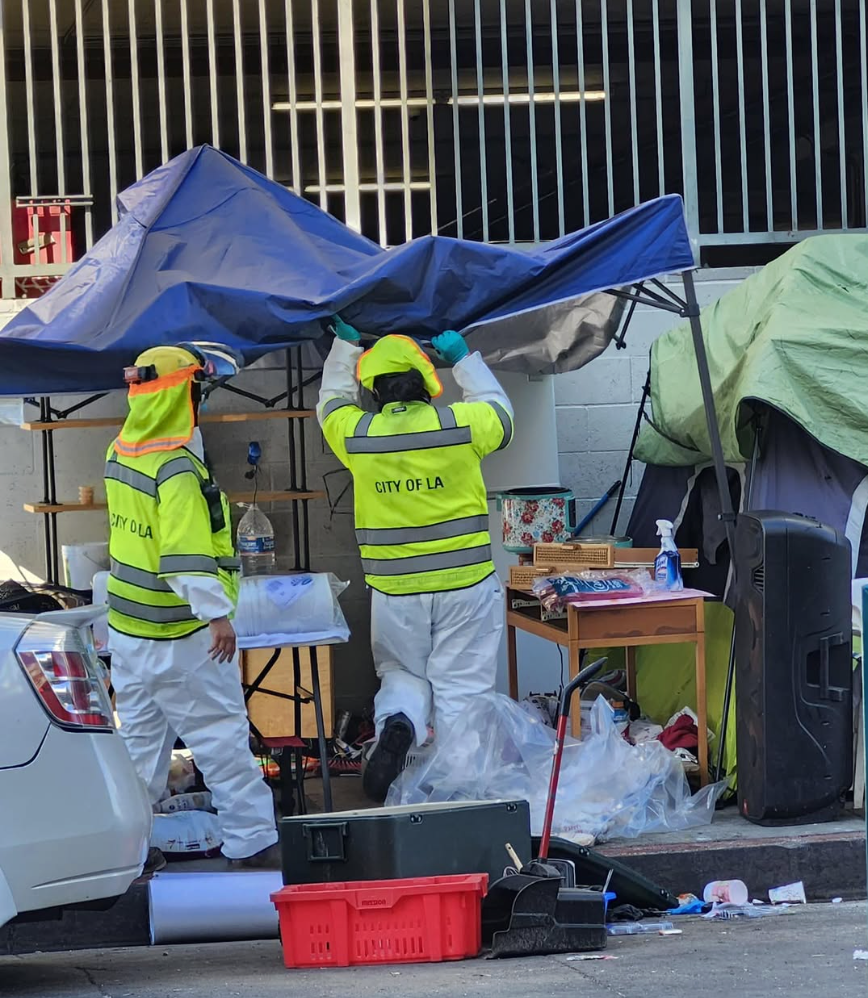
This Wednesday on Skid Row, a woman known to her neighbors as Chef Bless stood in the middle of what used to be her outdoor kitchen. The spot where she planned to cook Thanksgiving dinner for the block was nothing but a scraped-clean patch of pavement. Everything she had purchased with her own money was gone. Frozen chicken, goat, lamb, fish, shrimp, her pots and pans, her fuel, the tools she used every day, her tent, her clothes, and even the paperwork she kept tucked away for her entrepreneurship program. The City had come through with a brutal sweep, trashing everything she had.
To grasp the scale of the harm, it helps to understand who Chef Bless is. Despite being unhoused and stuck in an endless wait for apartment keys she was promised two months ago, she cooks for her neighbors every day. She brings people plates of food with real flavor, real pride, and real care. She feeds other unhoused residents, workers on the block, and anyone who needs a meal, and she is enrolled in a City program designed to help emerging chefs build a path out of homelessness. She had hope, momentum, and a plan. And a sweep destroyed it all overnight.
Chef Bless’ story is not an outlier. People across LA describe sweeps as violent and traumatic events that do not simply clear sidewalks but strip people of stability, identity, and safety. City workers routinely toss out belongings that are essential for survival. They slash or remove tents that keep people alive at night in a city where more unhoused people die of hypothermia than in Chicago and New York combined. Documents that prove identity or eligibility for benefits are lost. Many unhoused residents say they live in a constant state of fear that the small amount of order they have created can disappear at any moment. What the City calls “cleaning” is utter chaos and destruction for the people living through it.
When belongings disappear, people do not move indoors. They move further into crisis. They lose medications and gear that help them stay healthy. They lose the little pieces of stability that make it possible to apply for housing, hold on to paperwork, or simply stay alive long enough to try again. Los Angeles loses about seven unhoused residents a day, and each death is shaped by a landscape of displacement, confiscation, and constant disruption. These sweeps are expensive for the City and devastating for the people forced to endure them. They do not reduce homelessness, but deepen it.
The sweep that destroyed Chef Bless’s kitchen was recorded by community members with LA CAN’s Community Watch team, which has spent twenty years documenting the violence of these operations. That footage mattered, because what happened to her is part of a larger pattern. People who are trying to survive are repeatedly pushed back to zero, no matter how hard they work or how committed they are to their own future.
In the hours after the sweep, residents and supporters stepped in. People on social media and in the neighborhood shared her story and began pooling money to help her replace what was taken. Within about twelve hours, community members raised more than two thousand dollars to buy ingredients, tools, and supplies so she could still cook for the block. This was enough to rebuild her kitchen and restore her ability to work. Yesterday, she cooked Thanksgiving dinner for Skid Row after all because community care filled the void left by City policy.
Chef Bless’ story and so many others like hers should force a reckoning. When a woman who feeds her entire neighborhood can lose everything in a matter of minutes, the problem is not her, but a system that treats survival as an inconvenience and human beings as debris. Sweeps do not solve homelessness. They make it harder for people to live long enough to escape it, and they rip away the very stability that programs and outreach workers tell people they need. #StopTheSweeps