
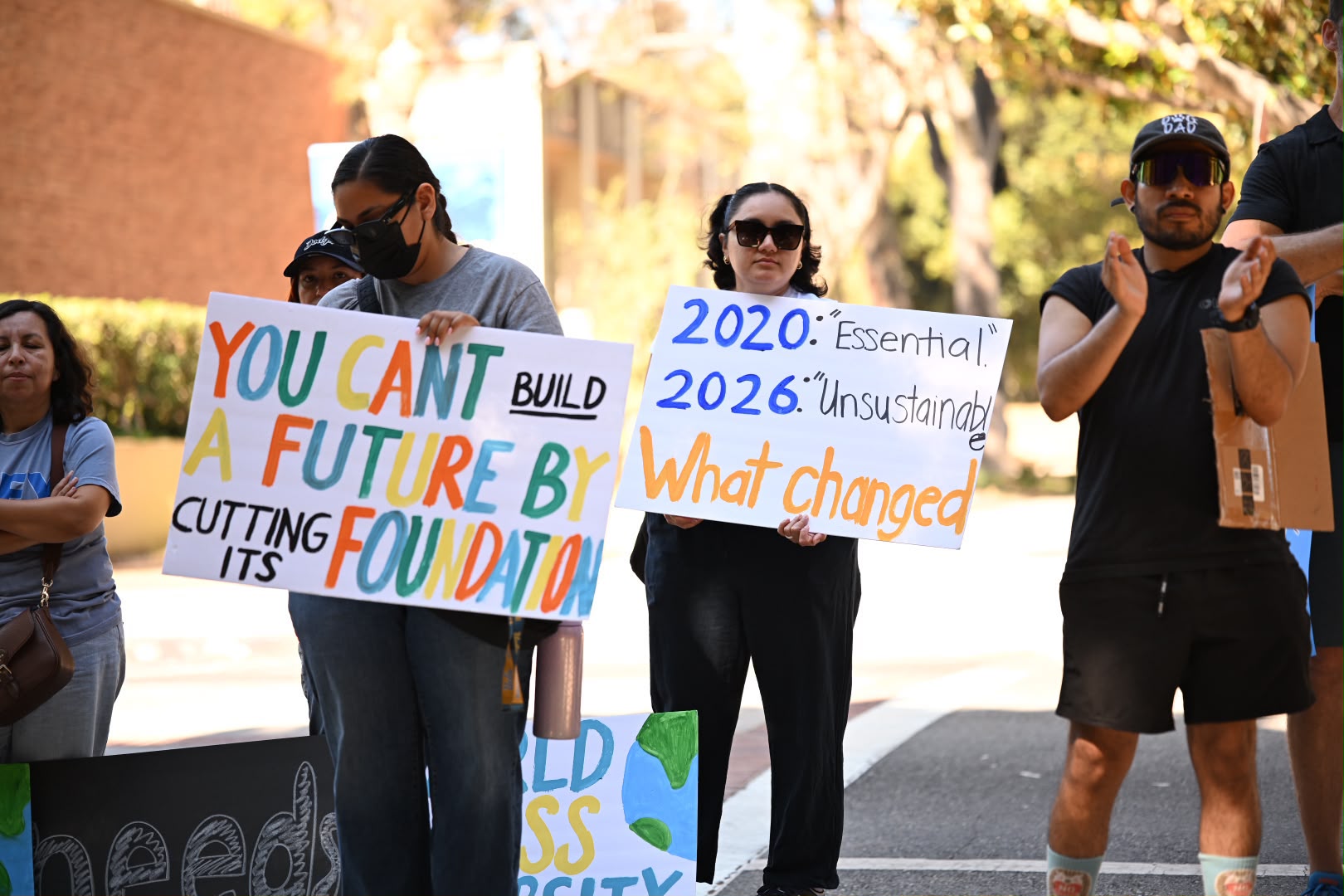
Photo credit: James Garcia, taken at the rally outside of Executive Vice Chancellor and Provost Darnell Hunt’s house on August 17, 2026.
UCLA’s sudden announcement on August 13 that it would shutter both of its child-care centers has left hundreds of parenting students, faculty and staff reeling, along with the dozens of administrators and teachers employed there. The centers provide subsidized child care for nearly two-thirds of the roughly 250 children attending, and have been a lifeline for low-income undergraduate and graduate students, many of whom would otherwise not be able to continue their studies while being parents. University Parents Nursery School (UPNS), which shares a building with one of the UCLA centers, will also have to close. The closures will limit child care options in a Westside already facing acute shortages, along with Los Angeles County as a whole.
The university’s explanation for the planned closure in June 2027 of its two Early Care and Education (ECE) centers was vague. In the email sent to parents, Executive Vice Chancellor and Provost Darnell Hunt cited ECE’s financial position as one of the factors considered, explaining that it had reviewed the “program’s operations, enrollment and long-term outlook,” and “determined that the program is not sustainable.” The ECE website says that the decision “reflects UCLA’s need to focus its resources on the university’s core mission of teaching, research and public service.”
Protesters at a rally on campus this Thursday said ECE currently has a $2 million budget deficit, which they juxtaposed with UCLA’s recent acquisition of the former Westside Pavilion mall for $50 million and the amount the university spends each year on campus security and athletic programs.
“This is a paltry sum for a university that takes in billions of dollars in tuition, grant money, contracts and revenues every single year,” Tirzah Blanche, whose son attended ECE while she was a graduate student at the UCLA Luskin School of Public Affairs, said at the rally. “They have made a choice of what they are going to prioritize and it is not their workers, their students, their faculty, or their community that rely on child-care services.”
For Miriam Torres, who was in her junior year at UCLA when her daughter was born, a subsidized spot at the center near her apartment in University Village family housing allowed her to stay enrolled as a full-time student and continue to work part-time to support her family. “I was a first-time mom, a solo mom…. I had a lot on my plate and so I needed that extra support. [ECE] has been such a huge help in my journey, both as a student and as a mother.”
Until 2023, UCLA provided a portion of the subsidies from its own budget, but since being moved into the university’s Department of Education and Information Sciences, the subsidies have come only from California’s Department of Education and Department of Social Services. California expanded the number of state-subsidized child-care spaces in the final budget signed by Governor Gavin Newsom last month, but still only funds enough slots to subsidize about 18 percent of the state’s eligible children.
Without subsidies, UCLA ECE charges monthly fees ranging by age from $2,315 to $3,300 for UCLA affiliates and from $2,470 to $3,775 for the wider community, reflecting the skyrocketing cost of child care for infants and toddlers on the Westside. Academic student workers at UCLA such as teaching assistants receive a child-care subsidy of about $1,400 per quarter (10 weeks), which does not even cover one month of child care.
“At the end of the day, it’s an equity issue,” said Michal David, a UCLA Law School alumna and partner of a UCLA graduate student. “The folks that are going to be most affected by this are folks who are already struggling, who are low-income.”
The childcare program at UCLA has also been a draw for international student families, who face limited options for working in the U.S. and are less likely to have family in the area to help with childcare. Trinidad Cruz and her partner decided to come to UCLA in 2025 from Chile for his LLM program instead of Georgetown because of the subsidized childcare provided here. Their daughter started at UPNS, which does not provide subsidized slots but is significantly less expensive than other options in the area, before being accepted at ECE with a subsidy.
Andrea Blanco Miranda, a landscape architect whose husband is doing a five-year PhD program in the business school, has had four children attend ECE with subsidies. She said the quality of care they received for each child meant that they did not have to compromise their children’s care for her or her husband’s career, and made her “very proud to be part of UCLA.” Like many, Blanco is concerned that the school will not be able to retain the same quality of care over the next year before the closure in June 2027. “How do they expect to keep staff? They may even have to close earlier,” she said.
Another international student couple from India who preferred to stay anonymous had just received word the day before the closure announcement that they had been offered a subsidized spot for their 5-month-old after being on the waitlist for months. One parent explained that “something like this kind of makes me question, or rethink, our decision of having come here [to the U.S.] in the first place. Not just the ECE closure, but all these decisions cumulatively over the last year, year and a half. It has been a very stressful time and this is one more factor to it. It does certainly seem like a very rocky road ahead.”
A transfer undergraduate student from a mixed-status household said at the rally that the news that his newborn may not be able to attend ECE was yet “another gut punch” for his family, already on edge due to threats from immigration enforcement activity across the country.
Faculty members are not eligible for subsidies but still rely on the option to put their children in reliable, quality childcare right on campus at the Krieger location. Yvonne Yang, a psychiatry professor at UCLA who has had two children at ECE, said being able to drive five minutes from her office to breastfeed her baby on her break gave her the peace of mind she needed to continue to work through the early months. “It really helps you be able to have a great relationship with your child, know that they’re in great hands, and then that then lets you focus on your work and your career and your service to the university and to other people better,” she said.
For working families in L.A. County, child care options are dwindling. Just over 500 nonprofit preschools have closed countywide since 2021, and more are facing budget pressures resulting from the rollout of universal transitional kindergarten (TK) programs since 2025. Infants and younger toddlers require a higher caregiver-to-child ratio, which means more staff on the payroll, so taking 4-year-olds out of child-care centers increases operating costs.
In addition to the financial issues, many parents and teachers believe that liability concerns factored into the university’s decision after a teacher at the centers was arrested in 2024 and found guilty in 2025 on nine counts involving child sexual abuse. At the rally on Thursday, parent organizers read a statement by a group of families whose children had either been abused by the teacher or experienced trauma in the wake of his arrest. “For all of us, our trauma was caused by years of organizational negligence and mismanagement that created the perfect conditions for a predator to prey on our children. Now [UCLA Chancellor Julio] Frenk is washing his hands of ECE. We won’t let him.”
The statement noted that the families are not pushing for the closure of ECE, but rather for transparency, accountability, and change. Families expressed frustration at the decision to place ECE in the university’s Department of Education and Information Sciences. “ECE is worth saving. Closing ECE because of liability is cowardly. ECE is only an untenable liability when it runs as a shadow unit of an academic unit that does not know how to care for children.”
Parents quickly organized after the email announcing the decision to close the centers went out on August 13, and have held two rallies so far to try to convince the university administration to reverse the decision. They are motivated in part by the fact that the university reversed its decision to stop providing food, diapers and formula in April this year within a week after parents protested against the decision. They have also cited decisions at Loyola Marymount University and the University of California Santa Cruz to keep childcare options available to the campus communities.
Parents and teachers delivered a petition to keep the centers open to the UCLA administration with 2,000 signatures after the rally on Thursday. “People are really ready to fight,” said Michal David. “We want to shame the university publicly.”
For updates and to support the effort to keep the child-care centers open, visit @saveuclachildcare and @ucla_bps on Instagram.
Lily Hindy is a PhD candidate in modern Middle East history at UCLA whose research examines human rights, migration, diaspora and nationalism, with a focus on the Kurdish nationalist movement in Iraq and the diaspora. Before coming to UCLA, she worked in foreign policy, journalism and the nonprofit sector, including at The Century Foundation, the Associated Press and RISC, which provides emergency medical training to independent journalists.