
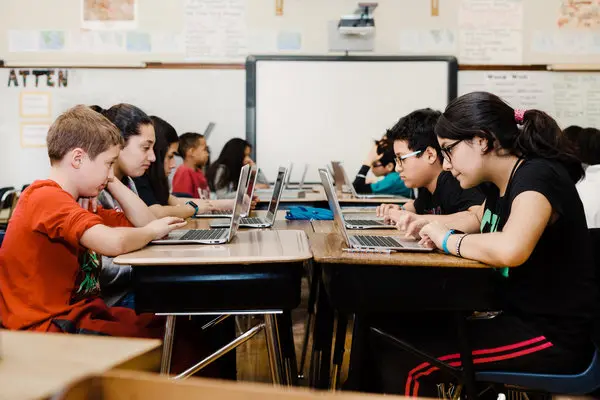
The LAUSD Board of Education voted this week to rein in how much time students spend on school-issued devices, signaling a shift away from years of expanding classroom screen use. The unanimous vote directs the district to develop a formal policy by June that would take effect next school year.
The move reflects a growing recognition among district leaders that the rapid expansion of one-to-one device programs during the COVID-19 pandemic never fully reset once students returned to classrooms. What began as an emergency response has, in many cases, become the default. Board member Nick Melvoin, who introduced the resolution, framed the issue as a course correction, pointing to reports of very young students spending large portions of the school day on screens.
Under the proposal, the most significant changes would apply to the youngest students. Children in preschool through first grade would be almost entirely prohibited from using district-issued devices during the school day, with limited exceptions for required testing. For students in second through fifth grade, the district would establish daily and weekly screen time limits, restrict access to platforms like YouTube, and encourage schools to move away from individually assigned devices toward shared classroom sets.
That raises an immediate question for many families about programs like i-Ready, which have become a routine part of classroom instruction across LAUSD elementary schools. i-Ready, widely used for math and reading diagnostics and practice, is considered an instructional tool rather than free student browsing. That distinction matters, since the policy is aimed primarily at reducing unsupervised or excessive screen use, not eliminating teacher-directed academic programs. In practice, that means i-Ready is likely to shrink but probably will not disappear outright.
For the youngest grades, the impact could be significant. If devices are largely removed from TK through first grade classrooms, i-Ready usage in those grades would likely be reduced to only what the district considers essential assessment, if it continues at all. For second through fifth grade, where screen time caps are expected, i-Ready would likely continue in a more limited, structured form, with shorter sessions and tighter limits on total weekly use.
Middle and high school students would face fewer restrictions but would still see changes, including limits on streaming platforms and restrictions on device use during lunch and recess. Teachers would retain flexibility to use screens for instructional purposes, drawing a distinction between guided classroom use and unsupervised student browsing.
The policy is separate from the district’s recent cellphone ban, which took effect last school year. That rule targeted personal devices brought from home. This new effort focuses instead on the Chromebooks and iPads distributed by the district itself, many of which remain in daily use years after they were first issued during remote learning.
Pressure for change has been building from parents across Los Angeles. Advocacy groups like Schools Beyond Screens have pushed the district to address concerns about attention, learning, and early childhood development. Parents have raised questions about whether heavy device use is crowding out foundational skills, particularly for younger students still learning to read and write.
What remains unclear is how much impact the policy will ultimately have. District leaders acknowledge the limits of school-based restrictions in a world where screens are ubiquitous at home. Supporters argue that establishing boundaries during the school day can help build healthier habits overall, but critics question whether those gains will hold once students leave campus.
The school board is expected to take up the full policy in June. Between now and then, the details will matter, including how limits are enforced, how schools adapt, and how programs like i-Ready are defined within those limits. The district has also been directed to review its broader ed-tech contracts, opening the door to changes not just in how long students use these tools, but how often and why.