
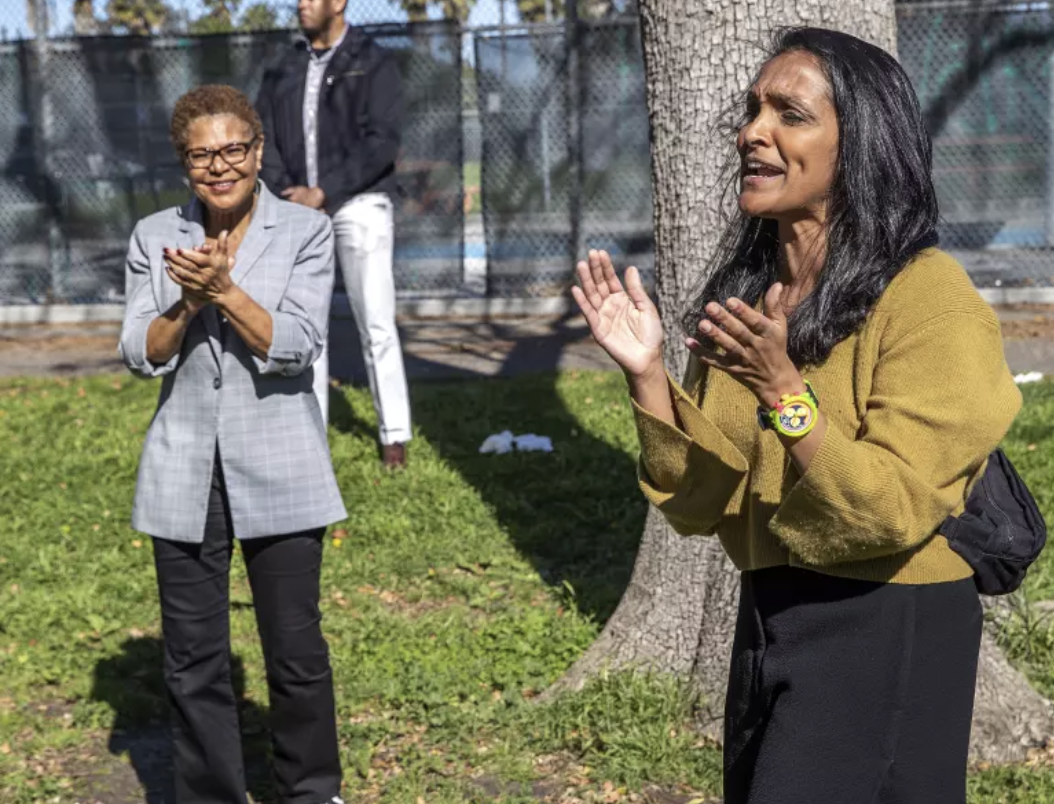
Los Angeles City Councilmember Nithya Raman announced yesterday that she is running for mayor, entering the race just before the filing deadline and immediately reshaping the field. Her candidacy adds another challenger to Mayor Karen Bass, but its most immediate political effect is to divide the progressive electorate at a moment when a movement candidate, Rev. Rae Huang, has already been campaigning for months from the left.
The timing of Raman’s decision is striking. Just three months ago, while attending a Democratic Socialists of America election night watch party celebrating Zohran Mamdani’s victory in New York, Raman praised Karen Bass, calling her “the most progressive mayor we’ve ever had in L.A.” That moment stood out to many in the room, not only because Bass’s governing record has placed her firmly in the centrist camp, but also because Raman’s relationship with DSA-LA had already become strained. She was the first candidate elected with the organization’s support, but in the years that followed she broke with DSA priorities on several high-profile votes, drew criticism for accepting support from Democrats for Israel, and was formally censured by the chapter.
Her entry into the mayor’s race months into Rae Huang’s campaign, without seeking endorsement or consultation, has reinforced concerns among some members that Raman has treated DSA more as a political brand than as a partner in co-governance. For organizers who see electoral work as part of a long-term project to build socialist power in LA, the fear is not only that the vote will split, but that the movement itself will be drawn into another cycle of internal conflict instead of focusing on expanding its base and winning new seats for actual socialist candidates.
Entering the race at the last possible moment also raises obvious questions about what is driving her campaign. One possibility is simple political opportunism. Bass’s approval ratings are abysmal, and Raman may smell blood in the water, calculating that she can carve out a viable lane by assembling a center-left coalition anchored by pro-development and YIMBY constituencies. Another possibility is that Mayor Karen Bass, facing declining approval and a serious challenge from her left, encouraged Raman to enter the race in order to split the progressive vote and prevent a movement candidate from consolidating enough support to advance.
We’ve seen this before. Crowded fields and late entries have split insurgent or progressive support, often benefiting establishment candidates and shutting actual progressive challengers out of the final round. In the 2020 presidential primary, many observers argued that Elizabeth Warren’s continued presence in the race divided the progressive vote at a crucial moment, weakening Bernie Sanders’ path to the nomination. Los Angeles politics offers its own examples. In the Council District 5 race, Scott Epstein mounted a strong campaign to the left of Katy Yaroslavsky while Sam Yebri ran to her right. Then Jimmy Biblarz entered late, split the progressive vote, and the result was a runoff between Yaroslavsky and Yebri. Whether intentional or not, the effect was the same.
There is also the structural consequence of Raman’s decision. If she were to win, her departure from City Council would trigger a special election in District 4, a seat that would likely fall into the hands of a conservative councilmember. In recent years, building a durable bloc on the Council capable of shaping budgets, housing policy, and public safety has been one of the left’s most important strategic goals. Losing even one seat would significantly weaken that effort.
In a top-two primary system, the stakes of division are real. Only the two candidates with the most votes advance, so when voters who want structural change are split across multiple candidates, that entire bloc can be shut out of the runoff. That matters in this race because the divide is not just personal or stylistic. It is between a movement candidate rooted in grassroots organizing and a candidate whose political base and governing approach are more closely tied to existing institutions. Rev. Rae Huang, who has been campaigning for months, comes out of organizing. Her campaign is rooted in tenants, workers, and neighborhood networks that have been fighting on housing, public safety, immigration, and affordability for years.
One of the clearest distinctions in this race is over public safety. Rae Huang’s campaign centers an explicitly anti-carceral, care-first vision, arguing that real safety begins with people having their needs met, housing, mental health care, and stable communities that prevent harm before it occurs. She supports scaling up non-punitive crisis response models and has been unequivocal in opposing the criminalization of homelessness, rejecting sweeps and enforcement-driven approaches in favor of housing and services.
Raman first ran for office in the aftermath of the George Floyd uprising, sharply criticizing the Los Angeles Police Department and calling for a fundamental rethinking of public safety. Many voters believed she would help lead that shift. But once in office, her record moved in a different direction. Raman voted for city budgets that increased LAPD funding and continued to support those increases in subsequent years, even after acknowledging criticism of her first vote. Other members of the progressive bloc, including Eunisses Hernandez and Hugo Soto-Martínez, have established a much more consistent pattern of voting against expansions of policing, surveillance, and enforcement powers, highlighting how sharply the records now diverge.
Those differences are taking on new urgency today, just as they did during the 2020 uprising. ICE raids and federal enforcement operations are forcing more Angelenos to confront the realities of policing firsthand. Communities are organizing rapid response networks and seeing more clearly how local law enforcement and federal agencies can operate alongside one another.
Huang’s position is explicit. She has called for Los Angeles to sever all ties with ICE and has argued that the agency itself should be abolished. She frames immigration enforcement, policing, and the criminalization of poverty as interconnected systems that must be addressed together. As these issues become more visible in daily life, the differences between candidates on public safety are becoming harder to ignore.
Housing policy presents a similar tension. Raman built her political identity on addressing displacement and the housing crisis. But her recent effort to pursue change to Measure ULA, the voter-approved tax on high-value property sales that funds affordable housing and tenant protections, raised alarm among tenant advocates. One of the most important redistributive housing policies LA has ever passed, ULA represents a significant victory for progressives that creates a dedicated funding stream for deeply affordable housing. Proposals to weaken or carve out exemptions inevitably raise questions about whose priorities are being served.
Over time, critics argue, Raman’s governing philosophy has come to reflect a belief that institutions will respond to careful negotiation and incremental reform. But many Angelenos increasingly believe the opposite. The system responds to pressure, and incrementalism is precisely what produced the crises we now face.
Raman’s record on Gaza has also been a major source of criticism from the left and a breaking point for many of her former supporters. In 2024, she accepted support from Democrats for Israel, triggering significant backlash and ultimately leading to a formal censure by DSA-LA. That episode reinforced concerns among some voters that she was willing to distance herself from movement positions when doing so was politically convenient.
Taken together, these issues create a growing perception that Raman is following a familiar political trajectory. She was elected on the energy of movements, then gradually repositioned toward the political center once in office. None of this means she cannot make a case to voters. She has governing experience, name recognition, and a reputation among some constituencies as pragmatic and detail-oriented. For voters who believe change comes primarily through working inside existing institutions, she may appear to be a credible candidate. But that is precisely the dividing line in this race.